-
The Rifle Squad
Organization.
Movement and formations.
-
St. Crispin’s Day
An interesting contrast to Kenneth Branaugh’s version. The Globe Theater.
Update: Looks like that one above succumbed to link rot. Try this version.
-
The Battle off Samar
For two decades prior to World War II, both the Imperial Japanese Navy and the United States Navy assumed any war in the Pacific would culminate in a decisive battle in the waters off the Philippines archipelago.
B0th navies built their fleets, their doctrine, their weapons, and their training around this assumption. And in late October, 1944, that battle was joined, the largest naval battle in history, The Battle of Leyte Gulf.
Spread over three days, and hundreds of thousands of square miles, it was a decisive defeat for the IJN. But on the 25th of October, one portion of the battle was very nearly a catastrophe for the US Navy, and only by the dint of extraordinary heroism and sacrifice was disaster averted.
In mid 1944, having consolidated the capture of the Marianas island chain, the Navy actually argued to bypass the Philippines, and instead invade Formosa.* But shipping and a shortage of available Army troops meant any invasion of Formosa would be delayed an unacceptable length of time. With the resources available, an invasion of the Philippines was practical. Further, GEN MacArthur strongly argued that the US had a moral obligation to fulfill his promise to return. The Philippine people, and all other Asian nations, he argued, would never forgive the US for a failure to attempt to liberate conquered peoples.
GEN MacArthur won the argument. The next objective in the Pacific would be his target. But President Roosevelt was loathe to place either MacArthur subordinate to ADM Nimitz, or ADM Nimitz under MacArthur. And so were sewn seeds of disunity of command.
Under Nimitz, VADM Halsey lead the Third Fleet in direct support of the invasion. But the actual invasion forces were under the US Seventh Fleet, which was under GEN MacArthur’s command.
The IJN plan to counter the invasion was, as so many of their plans, a complex one that divided the Japanese fleet into three forces, the Northern Force, the Center Force, and the Southern Force.
Northern Force was centered around the remnants of the Japanese carrier fleet. But the air wings of the fleet had been ground to a nub months earlier in the Great Marianas Turkey shoot, and so the force carried only a paltry 108 planes. It was, in actuality, a sacrificial decoy force, intended to draw Halsey and his stupendously powerful Fast Carrier Task Force away to the north.
The rest of the Japanese plan was for the Center force to pass north of Samar, and for the Southern Force to pass through the Surigao Strait, and for both to fall upon the lightly defended invasion forces at Leyte.
It didn’t turn out that way. The Center Force was attacked during the day of October 24th by Halsey’s carriers, and forced to turn back. The Southern Force, harassed by submarine and air attack was later annihilated in the Surigao Strait by waves of destroyer torpedo attacks and a masterful battleship and cruiser gun line in history’s last “Big Gun” naval battle.
The decisive victory had been won! Except, it hadn’t.
In the waters to the east of Samar, under the Seventh Fleet, three groups of small escort carriers were providing close air support to the troops ashore, and a Combat Air Patrol over the invasion fleet. Escort Carriers, known as CVE, were jokingly said to be Combustible, Vulnerable, and Expendable. Based on converted merchant hulls, they lacked many of the survivability measure of warships. Armed with a single 5”/38 gun on the stern, and with an airwing of about two dozen FM-2 Wildcat and TBM Avengers, they were well suited for their role supporting invasion forces.
Three groups of six CVEs were operated in support of the invasion, with the call sign “Taffy.” Taffy 3 was the northernmost group, under RADM Clifton A. F. Sprague.** In total, Taffy 3 had those six carriers, and an escort of three Destroyers (DD) and four Destroyer Escorts (DE).
At 0637 on October 25, 1944, a scout pilot from Taffy 3 was astonished to spot a massive Japanese force coming round Samar and headed right for Taffy 3. The Center Force, under ADM Kurita, turned back the day before, had countermarched and resumed its mission. The thirteen fragile ships of Taffy 3 now faced a force of four battleships, six heavy cruisers armed with 8” guns, two light cruisers armed with 6” guns, and eleven destroyers. Taffy 3 was doomed. No force could withstand such an onslaught.
Instantly, RADM Sprague made a series of decisions, every one of them correct. First, he called for help, especially from the other escort carrier groups. Second, he immediately turned away from the Center Force and ran as fast as his carriers could go. And third, he began launching every plane he could to throw at the Japanese. And fourth, he had his ships begin laying as much smoke as possible. While US ships used radar fire control, the Japanese fleet was still restricted to optical fire control.
An escort carrier had a maximum speed of about 18 knots. Every ship in the Japanese force was at least 10 knots faster, and many were twice as fast. Sooner or later, the Japanese would be able to run down the carriers.
The escorting destroyers and destroyer escorts place themselves between the carriers and the oncoming armada. USS Johnston, under the command of CDR Earnest Evans, immediately turned to make a torpedo attack on the Japanese. Soon the destroyer USS Hoel joined, and the destroyer escort USS Samuel B. Roberts as well. All three would soon be sunk with heavy loss of life. But the combined efforts of these three ships and the others of the escort, the furious air attacks by Taffy 3’s planes and those of the other escort groups staved off complete disaster.
In the end, ADM Kurita’s heavy cruisers first slowed, then sank the escort carrier USS Gambier Bay.
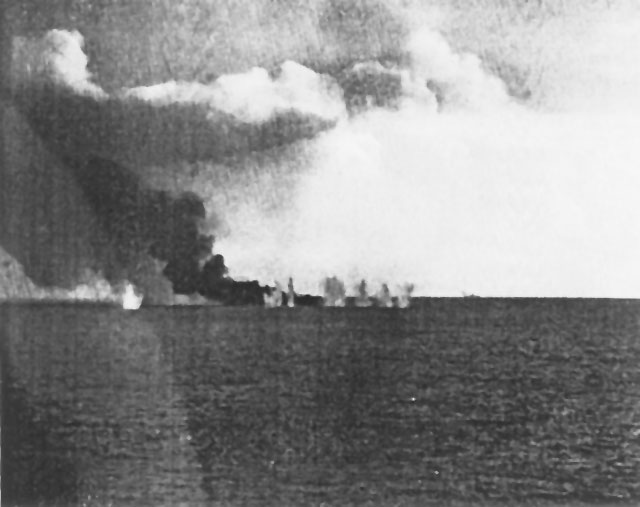
An 8-inch salvo from either Japanese cruiser Tone or Chikuma straddles the burning U.S. escort carrier Gambier Bay on October 25, 1944 during the Battle off Samar. The Japanese cruiser can be faintly seen in the center right of the photograph.
But the storm of fire from the escorts and the American planes cost the Japanese three heavy cruisers sunk, and three badly damaged. ADM Kurita, with victory within his grasp, took counsel of his fears. He recalled his force and attempted to make good his escape.
In just over two hours,the Japanese had inflicted 1000 fatalities upon Taffy 3, and sunk four ships.
But as historian Samuel Elliott Morrison notes his history of the battle, ADM Kurita’s failure was a very minor tactical victory when he should have inflicted a major operational defeat upon the US Navy. The IJN in October 1944 was a spent force. The role of the Center Force was a suicide mission. Had he persisted, he could have further battered Taffy 3, and far more importantly, he could have fallen amongst the invasion forces and done unimaginable slaughter to them.
While Taffy 3 escaped annihilation at the hands of ADM Kurita’s Center Force, it’s ordeal that day was far from over. Possibly the most fear inducing weapon the Japanese fielded in the war made its debut an hour later. For the first time, the Kamikaze corps would dive their planes to their doom, and their targets were the thin decks of the carriers of Taffy three. USS Kalinin Bay would suffer ghastly damage, and the USS St. Lo***, already badly damaged by gunfire, would succumb to a Kamikaze.
In the dark days of the summer and autumn of 1942 during desperate fighting in the Solomons Islands, US Navy ships, equipment, doctrine, leadership and training were often overmatched by their Japanese counterparts. Two years later, under some of the most trying circumstances imaginable, young sailors, many who had never been to sea before a few months before, performed magnificently, a feat of gallantry and bravery that has few, if any, rivals in US Navy history.
Should you be interested in learning more of this battle, I strongly recommend Last Stand of the Tin Can Sailors by James D. Hornfischer, and Samuel Elliot Morrison’s The Two Ocean War.
*Now known as Taiwan
**In an historical oddity, the southernmost group was under RADM Thomas Sprague, no relation to Clifton
***USS St. Lo was originally commissioned USS Midway, but that name was “clawed back” for the CVB class carrier CVB-41. Sailors say it is bad luck to rename a ship.
-
Daily Doctrine Man

-
Load POLARIS
Which, it’s a tad more involved than I realized.
-
First Member of American Military to Die Fighting ISIS Had Peaceful, Gentle Side : People.com
Army Master Sgt. Joshua Wheeler, who was the first American service member to be killed in action while fighting ISIS, was a peaceful, gentle man who was devoted to his family and proud to be in uniform, a relative tells PEOPLE”I want the world to know what a good person he was,” says his aunt, Elizabeth Brown, 45, of Jones, Oklahoma, “and how much he loved his family and his country.”Wheeler, 39, died from wounds received Thursday in the course of a hostage rescue operation in Kirkuk Province, Iraq, the Army confirms. The mission happened after freshly dug mass graves were spotted inside the compound, a military source with knowledge of events tells PEOPLE.
Source: First Member of American Military to Die Fighting ISIS Had Peaceful, Gentle Side : People.com

Friend of the blog SKK writes in People.com about MSG Joshua Wheeler, who died of wounds received in the successful hostage rescue in Iraq the other day.
That Delta went along (to advise and assist-wink-wink) on this raid is interesting, and raises the question, why this raid? There have been plenty of massacres. Was it just a matter of finally having actionable intelligence in time to effect a raid, or was there a particular reason why the special operations community wanted to stage this attempt?
-
Obama vetoes defense bill | TheHill
President Obama on Thursday took the rare step of vetoing a major defense policy bill, upping the stakes in a faceoff with Republicans over government spending. Obama used his veto pen on the National Defense Authorization Act during a photo-op in Oval Office. “I’m going to be vetoing this authorization bill. I’m going to be sending it back to Congress, and my message to them is very simple: Let’s do this right,” Obama said. It’s highly unusual for a president to veto the defense legislation, which typically becomes law with bipartisan support. The move amounts to a public rebuke of congressional Republicans, who warned that vetoing the $612 billion measure would put the nation’s security at risk. The veto was Obama’s third this year and the fifth of his presidency. The Defense authorization bill has been vetoed four times in the last half-decade. Obama argues the bill irresponsibly skirts spending caps adopted in 2011 by putting $38 billion into a war fund not subject to the limits, a move he called a “gimmick.” He has called on Congress to increase both defense and nondefense spending.
Source: Obama vetoes defense bill | TheHill
Don’t believe the White House spin on this. This isn’t about the OCO spending. What is IS about is two things. Obama wants to lift the limits on non-defense spending, and is holding the military budget hostage for that.
The other reason is that the NDAA explicitly prohibits closing Guantanamo Bay, and that also has the petulant President whining.
-
USAF: Expanded Risk of Neck Damage to F-35 Pilots

WASHINGTON — Weeks after Defense News revealed that the military services had restricted lightweight pilots from flying the F-35 joint strike fighter, the US Air Force officially acknowledged an increased risk of neck damage during ejection to middleweight pilots as well.In a news release issued Oct. 16, the Air Force confirmed a Defense News report that pilots under 136 pounds are currently barred from flying the fifth-generation aircraft, expected to be the backbone of American airpower for decades to come. It also acknowledged an “elevated level of risk” for pilots between 136 and 165 pounds.”We expect the manufacturer to find and implement a solution,” said Air Force Secretary Deborah Lee James in the statement.Testers this summer discovered an increased risk of neck damage when a lightweight pilot is ejecting from the plane.
Source: USAF: Expanded Risk of Neck Damage to F-35 Pilots
The usual F-35 critics are coming out and using this as an example that the F-35 program can simply do no right.
Well, maybe so. But there’s a bit of nuance here you should be aware of.
The F-35 is the first jet designed since the decision to open fighter planes to females. And so it is the first to be built with the tendency of women to be smaller and lighter than their male counterparts in mind. That means the Martin Baker US16E seat was designed with a wider envelope of suitable pilot weights than any seat before it. If there’s another operational ejection seat that’s cleared to carry a 103 pound pilot, that’s surely news to me.
The other issue here is that the F-35 (and thus the MB US16E) is the first jet designed with helmet mounted displays in mind. The seat designers were well aware that helmet mounted displays mean heavier helmets, which means the inertia is greater than in other ejection scenarios, and the risk of a head displacement is greater than in other previous designs. And so they’ve taken steps to mitigate that risk. For instance, the US16E uses airbags mounted at the top of the seat to keep the pilot’s head from moving left or right.
And finally, the issue at hand here with lightweight pilots? This is the only seat in the inventory that has ever studied this parameter. You’d think after 70 years, ejection seats are relatively easy to design. But the fact is, they have to operate in such a wide range of speed and altitudes, and complete a variety of tasks in precision timing. They grow ever more complex. For instance, if you are forced to eject at high speed and high altitude, you want the seat to do things quite a bit differently than if you must eject at low speed and low altitude.
The US16E is the single most tested ejection seat during its development ever. Given the development costs, common sense suggests the proper answer isn’t fixing the issue associated with pilots in the 103 to 136 weight range. That population is so small, it makes far more sense to restrict those pilots to other aircraft, and save the money.
Finally, no matter how sophisticated a seat is, ejection will always be fraught with possibilities for injury or even death. Military aviation is far safer today than it was a generation ago. But even today, it is a hazardous undertaking, and we still lose fine men and women to those hazards.
-
Paras win 15-year battle to reinstate Pegasus emblem – Telegraph

The Parachute Regiment has won a 15-year-long battle to reinstate its famous wartime Pegasus emblem, after it was controversially axed in a defence shake-up.The badge had been regarded as the trademark of Britain’s airborne forces and was approved by Winston Churchill, but was retired in 1999 against stiff opposition from retired officers and politicians who argued it was part of the Paras regimental history.
Source: Paras win 15-year battle to reinstate Pegasus emblem – Telegraph
Finally. I remember when they removed it.
Part of the argument was that Pegasus wasn’t inclusive enough, since the Air Assault brigade was more a helicopter landing force than an actual airborne organization.
But of course, that ignores the history of the Pegasus patch in the first place. The Pegasus bridge force that came to epitomize the elan and valor of the British airborne forces was, in fact, not an airborne formation, but a glider force.
-
American killed as U.S., Iraqi commandos free dozens of ISIL hostages
A U.S. servicemember died after a commando raid Thursday freed about 70 hostages believed to face imminent execution by Islamic State fighters in northern Iraq, the Pentagon said.The soldier’s death marked the first American combat death in Iraq in four years and raises the issue of deepening U.S. involvement on the ground there, something President Obama and the Pentagon have routinely ruled out.Pentagon press secretary Peter Cook insisted that U.S. participation in the firefight did not indicate a shift in U.S. policy, calling the circumstances leading to the raid unique. “U.S. forces are not in an active combat mission in Iraq,” he said.
Source: American killed as U.S., Iraqi commandos free dozens of ISIL hostages
A successful raid, but since an American serviceman was killed, President Obama has already distanced himself from it, saying it was SecDef Carter that authorized the mission. You and I both know had there not been a US casualty, Obama would have been trumpeting this success.
It is, of course, a calamity for the family and friends of this fallen warrior. But I do hope they can take pride in the fact that he fell saving the lives of others. Rest in peace, Soldier, secure in the knowledge that you have done your duty.

-
Subscribe
Subscribed
Already have a WordPress.com account? Log in now.
 XBradTC