-
TOW Missile Live Fire
A platoon of Bradley’s from 2-12 Cav conduct a TOW missile live fire at Graf in Germany.
That’s a heck of a lot of missiles. Back in my day, you’d be lucky to be allocated one missile, maybe two, for an entire platoon.
You’ll notice a small pop just before launch. When the gunner squeezes the trigger, that sends power to the missile, spins up the missile gyros, and activates the thermal battery to provide internal power to the missile.
It’s also pretty cool to see the guidance wires strung out, and the automatic wire cutting function. The impact fuze not only detonates the warhead, but it also sends the wire cut signal back to the launcher.
-
Grumman EF-111 Raven

EF-111s from 42nd Electronic Combat Squadron in Upper Heyford, England format off the tanker. The Grumman EF-111 Raven was the USAF’s counterpart to the Grumman EA-6B Prowler electronic warfare aircraft. In USAF service the “Spark ‘vark” as it’s perhaps more commonly known, replaced the EB-66 Destroyer and the EB-57 Canberra.

The Grumman EF-111 Raven first flew on 10 March 1977. The first fully equipped EF-111 first flew on 10 March 1977 using a modified F-111. A grand total of 42 old F-111 airframes were produced at a cost to taxpayers of $1.5 Billion.
In terms of flight control the EF-111 (by modern standards) is pretty straight forward. As with the standard F-111, there are no ailerons, as roll is controlled differentially by the horizontal stabilators and at low speeds spoilers on the upper surface of the variable geometry wings. Pitch is controlled by both horizontal stabilators and the rudder acts to correct adverse yaw. There are also tangential ventral fins that add to high-speed longitudinal stability.
Even though the Raven can be seen as a counterpart to the Navy’s Prowler there are some key differences.
Metric Prowler Raven Maximum Speed (mph) 651 1460 Range (miles) 2400 (with drop tanks; usually carried) 2,000 Ceiling (ft) 37,600 45,000 Rate of climb (ft/min) 12,900 11,000 Thrust/weight ratio (lbs/ft) 0.34 0.598 These performance differences enabled the Raven to do some things operationally that the Prowler could not. The Raven could keep up with supersonic strike aircraft like the F-111 and later the F-15E in the escort strike role. However the Raven doesn’t have the endurance that the Prowler had because of a few factors. The Raven has a crew of 2, limiting the crew tasking loading for a given mission. The Prowler has a crew of 4 enabling more tasks to be spread to more crew members. The Raven uses “flying boom” method for aerial refueling which limits the tanker aircraft to refuel the aircraft to USAF-only tanking assets. The Prowler had the ability for fire the AGM-88 HARM (High Speed Anti-Radiation Missile) while the Raven did not.
 Both aircraft did use the AN/ALQ-99 Tactical Jamming System (TJS). The Raven specifically used the AN/ALQ-99E variant which had more automation for the 2 crew members and about 70% commonality with the Prowlers TJS (at least the earlier versions of the TJS).
The EF-111 houses components of the AN/ALQ-99E within the aircraft. The most visible changes to the EF-111 are the “canoe” in the ventral fuselage (that replaced the PAVE TACK pod in the F-111 variants, the “football” atop the vertical stabalitor, and an antenna on each wing glove for the ALQ-137 low/mid/high band reciever (port) and the ALR-62 forward RWR (starboard).

Components of the AN/ALQ-99E are seen on the “football” atop the vertical tail. 
This EF-111 show the ventral “canoe” fairing stowing the components of the AN/ALQ-99E TJS. The bullet fairing top is the AN/ALQ-137 multi-band receiver. 
EF-111 cutaway. Click to embiggenify. Operationally, the first EF-111s were deployed in November 1981 to the 388th Tactical Electronic Squadron, Mountain Home AFB, Idaho. From 1984 to 1992 the –111 saw service with the 42nd Electronic Combat Squadron (part of the 20 Tactical Fighter Wing) at RAF Upper Heyford, UK. The –111 also saw service with the 27th Fighter Wing at Cannon AFB in the 429th (1992-1998) and the 430th (1992-1993) Electronic Combat Squadrons. Also at Mountain Home AFB with the 388th (1981-1982) and the 390th (1982-1992) Electronic Combat Squadrons.
The EF-111 first saw combat with the 20th TFW as part of Operation El Dorado Canyon against Libya in 1986. Then during Operation Just Cause in Panama in 1989.
The largest EF-111 deployment for the EF-111 was Operation Desert Storm. The 18 EF-111s in the AOR flew over 900 sorties with a mission capable rate of 87.5 % mission capable rate. EF-1111 frequently operated with the F-4G and because the Iraqis feared the F-4G and its HARM missile, they made brief, limited and ineffective use of their radars. When they did choose to operate these radars, the effective jamming of the EF-111 negated their ability to track, acquire, and target attacking aircraft. Every day the Weasels and Ravens supported shooters as they attacked their targets in Iraq and the Kuwaiti Theater of Operations (KTO). One sign of their success was that after day four, all allied aircraft operated with impunity in the mid to high altitude environment across the AOR. By decreasing the threat of SAMs to our strike aircraft, EF-111s and F-4Gs permitted aircraft to deliver their weapons from an environment where they can be very lethal.
A notable event was a “maneuver” kill by an EF-111 of an Iraqi Air Force Mirage F-1EQ on the opening night of Desert Storm:
On the first night of the war, Captain Brent Brandon was flying his EF-111 “Spark Vark” on an electronic warfare mission ahead of a group of jets on a bombing run. Several IRAF Dassault Mirage F1s came in and engaged the flight. One of them went after the unarmed EF-111. Captain Brandon executed a tight turn and launched chaff to avoid the missiles being fired by the Mirage. A F-15 on the same flight, piloted by Robert Graeter, went after the Mirage trying to protect the EF-111. The Mirage launched a missile which the Raven avoided by launching chaff. Captain Brandon decided to head for the deck to try to evade his pursuer. As he went down he pulled up to avoid the ground, the Mirage followed him through, though the Mirage went straight into the ground. An unarmed EF-111 thus scored an air-air victory against a Dassault Mirage F1, although Graeter was credited with a kill. The EF-111A pilots won the Distinguished Flying Cross

An Iraqi Air Force Mirage F-1EQ. The aircraft was EF-111 66-0016 and is on display at the Cannon AFB Museum:

EF-111 66-0016 on outside display at Cannon AFB New Mexico. There was one combat loss of the EF-111 during Desert Storm:
On 13 February 1991, EF-111A, AF Ser. No. 66-0023, callsign Ratchet 75, crashed[11] into terrain while maneuvering to evade a perceived enemy aircraft threat killing the pilot, Capt Douglas L. Bradt, and the EWO, Capt Paul R. Eichenlaub
After Desert Storm the F-111 also flew missions in Operation Provide Comfort,Operation Northern Watch and Operation Southern Watch.
The victory from Desert Storm was shoret lived. The last deployment of the Spark ‘vark was 1998 to Prince Sultan Air Base in Saudi Arablia. Due to the aircraft’s age the USAF decided to retire the aircraft and the last EF-111s were retired on 2 May 1998, at Cannon AFB, New Mexico.
Aside from the EC-130, and the later “acquisition” (if you will) of the Prowler, the USAF pretty much ignored tactical electronic warfare. You can pick up that part of the story here.

EF-111 retired at AMARG. -
The sinking of HMS Implacable
First, you have to credit the Royal Navy. They knew how to name ships.
Second, they knew a good deal when they saw one. In the Napoleonic Wars, the Royal Navy ruled the waves, but arguably, the French built the better ship. And the RN, being practical seamen, when they captured a French ship, simply put it into service.
Laid down in 1797, launched in 1800 and entering service with the French Navy as the Duguay-Trouin, she would be one of four French ships of the line to escape capture at Nelson’s epic victory, Trafalgar. But she would not long escape the clutches of the RN. Two weeks later, at the Battle of Cape Ortegal, she would be captured.
Repaired and placed into RN service under the new name HMS Implacable, she would fight with distinction throughout the rest of the Napoleonic Wars. She would fight again at Acre and Syria in 1840. But by 1842, she was unfit for further frontline service. Like many wooden ships of the line, she w0uld continue to serve in various training ship roles, and eventually end her days as a hulk.
By the mid-twentieth century, she was the second oldest ship of the Royal Navy, behind the mighty flagship, HMS Victory. But post World War II austerity in Britain meant there were no funds for restoration or refurbishment. In 1949, she was towed to sea, and scuttled. As a fitting gesture, an escort of the French Navy was present to render honors, and she slipped beneath the waves flying the French Flag alongside the White Ensign.
H/T to the Aubrey-Maturin Appreciation Society for spotting the film.
-
Angled Flight Decks: 1930s Naval Innovation?
Angled flight decks on aircraft carriers enable modern aircraft carriers to simultaneously conduct takeoffs and landings by aircraft. Previously, in the 1910s till about 1945, aircraft carrier flight decks were “axial” flight decks with no special angled area with which to manage aircraft. In this case “go-arounds” were much more difficult and in the event of a landing accident, the aircraft was caught by a barricade stretched across the width of the flight deck. Flight operations consisted on either takeoffs/launches OR landings. After landing, the aircraft would taxi forward out of the landing area, to clear it for the next aircraft. Parking the aircraft was typically done in the forward portion of the flight deck.

HMS Argus (circa 1917) is typical of the first aircraft carriers. Note the full length axial flightdeck. Photo credit: Wikipedia. 
This head on view of the USS Enterprise (CV-6) taken during World War 2 again shows the narrow axial deck design that was still prevalent during that time. Naval Historians credit the Royal Navy, and specifically Rear Admiral Dennis Cambell with the invention of the angled flight deck:
The angled flight deck was invented by Royal Navy Captain (later Rear Admiral) Dennis Cambell, as an outgrowth of design study initially begun in the winter of 1944-1945 when a committee of senior Royal Navy officers decided that the future of naval aviation was in jets, whose higher speeds required that the carriers be modified to “fit” the needs of jets.[13][14][15] With this type of deck — also called a “skewed deck”, “canted deck”, “waste angle deck”, or the “angle” — the aft part of the deck is widened and a separate runway is positioned at an angle from the centreline.[16] The angled flight deck was designed with the higher landing speeds of jet aircraft in mind, which would have required the entire length of a centreline flight deck to stop.[16] The design also allowed for concurrent launch and recovery operations, and allowed aircraft failing to connect with thearrestor cables to abort the landing, accelerate, and relaunch (or “bolter“) without risk to other parked or launching aircraft.
The angled desk indeed allowed for the simultaneous launch and recovery of aircraft. The first aircraft carrier with the angled flight deck was the HMS Triumph (R16) which was tested in 1952:
In 1952, HMS Triumph was used for the first trials of an angled flight deck. Her original deck markings were obliterated and replaced with new ones at an angle to the long axis of the ship. The success of these trials led to the development of the now standard design, with additional areas of the flight deck added to the port side of the ship

HMS Triumph seen in 1950 before the deck marking modification in 1953. Photo credit Wikipedia. 
This diagram of HMS Triumph shows the 5.5 degree deck marking used in tests by the Royal Navy. Photo credit: Wings of the Navy: Testing British and US Navy Carrier Aircraft. The US Navy tested the markings for an angled flight deck on the USS Midway (CV-41) in 1952. “However the orientation of the arresting gear and barriers remained oriented to the axial flightdeck.”

This view of the USS Midway, just after her commissioning on 10 September 1945, illistrates her “pre-conversion” straight flight deck. 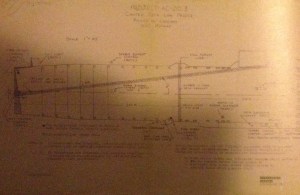
These are the deck plans for angled modifications aboard the USS Midway in 1952. Photo credit: Wings of the Navy: Testing British and US Navy Carrier Aircraft. The USS Antietam (CV-3) had the first “true” angled flight deck, as structural changes to the ship were made to accommodate that feature.

USS Antietam showing her 8-degree angled flight deck. Photo credit: Wikipedia 
The USS Antetiam with her original axial flight deck. However upon reading Dr. John T Kuehn’s Agents of Innovation: The General Board and the Design of the Fleet That Defeated the Japanese Navy, it seems that the angled flight deck is a United States Navy invention, not as always thought, a British invention.
Before I get to that a bit about the General Board and flying deck cruisers. The General Board was established in 1900 to play a critical role in linking the Washington Naval Treaty and innovation in the fleet. “Particularly astonishing, given the hierarchical nature of the U.S. Navy, was the General Board’s tolerant and consensus-driven process which led to an environment highly favorable to creativity and innovation.”
The flying deck cruiser was an attempt by the General Board to use remaing Washington Treaty warship tonnage allocation to meet the perceived aviation needs for the Navy war plan in the Pacific, unknown as War Plan Orange.
During one particularly interesting meeting of the Board in December 1930 a design for a ship called the “flying deck cruiser” was undergoing review by the general board which lead to a very interesting discussion:
The refined design included one feature in particular that had received little discussion during the hearings but was an outgrowth of them. During the December 1930 hearings, the Board had questioned the BuAer (Bureau of Aeronautics, the part of the Navy responsible for Naval Aviation) officers at length regarding launching and recovering aircraft on the shortened deck of some of the designs. The aviators had brought up the technique of taking off at an angle in order in order to avoid the island, or perhaps a forward superstructure, as well as to get a longer deck run. Evidently, the BuC&R officers has paid close attention because they included and angled flightdeck in the design. It was offset to the port (left) side of the ship in order to give the aviators more usable deck space for spotting (parking) and flight operations (Kuehn, p.118).
If the US Navy had built this ship they would have learned the same lessons we now know about angled flight decks about a generation before the angled deck carrier.
Here’s a line drawing of what she may have looked like:

The 1920s and 1930s represent a period of unparalleled and rapid technical innovation in the US Navy and the angled flight deck is only one example (even if the CF was never built).
There were quite a few Naval innovations that took place as a result of the Washington Naval Treaty, the Fleet Problem exercises and War Plan Orange and I’ll be posting more about those in the future.Sources (you can buy all these books by using the Amazon Store link to the right):
Wings of the Navy: Testing British and US Carrier Aircraft by Captain Eric “Winkle” Brown
US Aircraft Carriers: An Illustrated Design HIstory by Norman Polmar
Agents of Innovation: The General Board and the Design of the Fleet That Defeated the Japanese Navy (make sure that you buy this book (through the Amazon link right). It’s an excellent and interesting read).
-
F-111B Carrier Suitability Tests
We shared video a few days ago of the first F-35C carrier test landings and launches.
Before the Navy ever sends a new plane out to the ship, they test at a land based facility, normally Lakehurst, New Jersey, where catapults and arresting gear identical to those on the carrier are installed on a runway.
The failed F-111B variant underwent carrier suitability testing in the late 1960s, even after production was cancelled in favor of what would become the F-14.
-
Orion poised to fly December 4th.
NASA’s Orion space vehicle is scheduled to make its first (unmanned) flight on December 4th. Like most first flights, it’s objectives are fairly modest. Toss it up, make a couple orbits, come back down. The one really aggressive move it will be making is that the orbits will be highly elliptical, with a maximum altitude of about 3,600 miles. That the highest orbit for a man rated vehicle in about 40 years.
Why do this? Because Orion is not simply designed for low earth orbit, but rather for deep space exploration, potentially lunar or even Mars orbital missions. When you return from lunar flight, the reentry speed is much, much greater than from simple low earth orbit.
Not only will Orion use its power to achieve a higher orbit, it will use its engines to artificially accelerate to mimic that higher reentry speed. A similar test was done during the Apollo program.
Here’s a look at the first quarter 2014 progress report.
-
Two to Tango? Argentina Looking Everywhere for New Warplanes
Argentina’s air force is having a hard time maintaining its core Nesher/”Finger” fighters, even as the Kirchner regime seeks to take control of the Falkland Islands and their potential offshore oil reserves. That led Argentina to search for new fighter options, as the most reliable way of projecting power to likely exploration zones. Britain’s defenses are also much more run down than they were in the 1980s, and their complete lack of a carrier force leaves ongoing protection of the islands’ surrounding economic zones to just 2-4 Eurofighter Typhoon fighters, an offshore patrol vessel, and part of a regular navy ship rotation.
via Two to Tango? Argentina Looking Everywhere for New Warplanes.
A very interesting look at Argentina’s efforts to update its fighter fleet. Right now, the most capable airframe it has is the A-4AR Fightinghawk, remanufactured late model A-4 Skyhawks, with a good radar and avionics. As capable as the A-4AR is, it’s not an air to air platform. The older Nesher fighters, bought surplus from Israel, are outdated, have poor avionics, and even poorer weapons.
And there are any number of countries that would love to sell capable fighters to Argentina. Money is, after all, money.
But Britain, even with its defense budget in tatters, still has considerable economic influence. And of all the decent fighters available, most have at least one major component that ultimately is supplied by the USA. And the US maintains an option to restrict the “end user” of any US made components.
For instance, the article mentions a possible sale of surplus Israeli Kfir fighters to Argentina. But the Kfir is powered by the US J79 engine.* The US would have to approve any such sale.
The Obama administration has a nasty tendency to slight Britain, and support the foes of our allies, so there is no guarantee that the US would stop any Kfir sale. But its almost certain that the next administration would, or at least demand sufficient concessions from Argentina to placate the reasonable British fears of heightened tensions.
*actually built under license in Israel, but the end user restrictions still apply.
-
Cyber Monday
Just a reminder that we’re an Amazon affiliate, and you can support the blog by doing your holiday shopping by entering Amazon via our link on the right sidebar. You get the same price, and I get a nice referral payment.
-
Load HEAT- Holly Marie Combs
I’ve never seen Pretty Little Liars or much of Charmed, but I still remember Holly Marie Combs work on Picket Fences.


-
Snowbirds
In these parts, the term Snowbirds refers to retirees from the northern states that spend their winters here, and then return home for the warmer months.
But if you go far enough north, Snowbirds refers to the excellent Canadian flight demonstration team.





-
Subscribe
Subscribed
Already have a WordPress.com account? Log in now.
 XBradTC