-
The Battle off Samar- A repost from last year
October 25 is an interesting day in history, with several significant battles occurring on this day. Agincourt, Balaclava, and of course, the Battle of Samar.
For two decades prior to World War II, both the Imperial Japanese Navy and the United States Navy assumed any war in the Pacific would culminate in a decisive battle in the waters off the Philippines archipelago.
Both navies built their fleets, their doctrine, their weapons, and their training around this assumption. And in late October, 1944, that battle was joined, the largest naval battle in history, The Battle of Leyte Gulf.
Spread over three days, and hundreds of thousands of square miles, it was a decisive defeat for the IJN. But on the 25th of October, one portion of the battle was very nearly a catastrophe for the US Navy, and only by the dint of extraordinary heroism and sacrifice was disaster averted.
In mid 1944, having consolidated the capture of the Marianas island chain, the Navy actually argued to bypass the Philippines, and instead invade Formosa.* But shipping and a shortage of available Army troops meant any invasion of Formosa would be delayed an unacceptable length of time. With the resources available, an invasion of the Philippines was practical. Further, GEN MacArthur strongly argued that the US had a moral obligation to fulfill his promise to return. The Philippine people, and all other Asian nations, he argued, would never forgive the US for a failure to attempt to liberate conquered peoples.
GEN MacArthur won the argument. The next objective in the Pacific would be his target. But President Roosevelt was loathe to place either MacArthur subordinate to ADM Nimitz, or ADM Nimitz under MacArthur. And so were sewn seeds of disunity of command.
Under Nimitz, VADM Halsey lead the Third Fleet in direct support of the invasion. But the actual invasion forces were under the US Seventh Fleet, which was under GEN MacArthur’s command.
The IJN plan to counter the invasion was, as so many of their plans, a complex one that divided the Japanese fleet into three forces, the Northern Force, the Center Force, and the Southern Force.
Northern Force was centered around the remnants of the Japanese carrier fleet. But the air wings of the fleet had been ground to a nub months earlier in the Great Marianas Turkey shoot, and so the force carried only a paltry 108 planes. It was, in actuality, a sacrificial decoy force, intended to draw Halsey and his stupendously powerful Fast Carrier Task Force away to the north.
The rest of the Japanese plan was for the Center force to pass north of Samar, and for the Southern Force to pass through the Surigao Strait, and for both to fall upon the lightly defended invasion forces at Leyte.
It didn’t turn out that way. The Center Force was attacked during the day of October 24th by Halsey’s carriers, and forced to turn back. The Southern Force, harassed by submarine and air attack was later annihilated in the Surigao Strait by waves of destroyer torpedo attacks and a masterful battleship and cruiser gun line in history’s last “Big Gun” naval battle.
The decisive victory had been won! Except, it hadn’t.
In the waters to the east of Samar, under the Seventh Fleet, three groups of small escort carriers were providing close air support to the troops ashore, and a Combat Air Patrol over the invasion fleet. Escort Carriers, known as CVE, were jokingly said to be Combustible, Vulnerable, and Expendable. Based on converted merchant hulls, they lacked many of the survivability measure of warships. Armed with a single 5”/38 gun on the stern, and with an airwing of about two dozen FM-2 Wildcat and TBM Avengers, they were well suited for their role supporting invasion forces.
Three groups of six CVEs were operated in support of the invasion, with the call sign “Taffy.” Taffy 3 was the northernmost group, under RADM Clifton A. F. Sprague.** In total, Taffy 3 had those six carriers, and an escort of three Destroyers (DD) and four Destroyer Escorts (DE).
At 0637 on October 25, 1944, a scout pilot from Taffy 3 was astonished to spot a massive Japanese force coming round Samar and headed right for Taffy 3. The Center Force, under ADM Kurita, turned back the day before, had countermarched and resumed its mission. The thirteen fragile ships of Taffy 3 now faced a force of four battleships, six heavy cruisers armed with 8” guns, two light cruisers armed with 6” guns, and eleven destroyers. Taffy 3 was doomed. No force could withstand such an onslaught.
Instantly, RADM Sprague made a series of decisions, every one of them correct. First, he called for help, especially from the other escort carrier groups. Second, he immediately turned away from the Center Force and ran as fast as his carriers could go. And third, he began launching every plane he could to throw at the Japanese. And fourth, he had his ships begin laying as much smoke as possible. While US ships used radar fire control, the Japanese fleet was still restricted to optical fire control.
An escort carrier had a maximum speed of about 18 knots. Every ship in the Japanese force was at least 10 knots faster, and many were twice as fast. Sooner or later, the Japanese would be able to run down the carriers.
The escorting destroyers and destroyer escorts place themselves between the carriers and the oncoming armada. USS Johnston, under the command of CDR Earnest Evans, immediately turned to make a torpedo attack on the Japanese. Soon the destroyer USS Hoel joined, and the destroyer escort USS Samuel B. Roberts as well. All three would soon be sunk with heavy loss of life. But the combined efforts of these three ships and the others of the escort, the furious air attacks by Taffy 3’s planes and those of the other escort groups staved off complete disaster.
In the end, ADM Kurita’s heavy cruisers first slowed, then sank the escort carrier USS Gambier Bay.
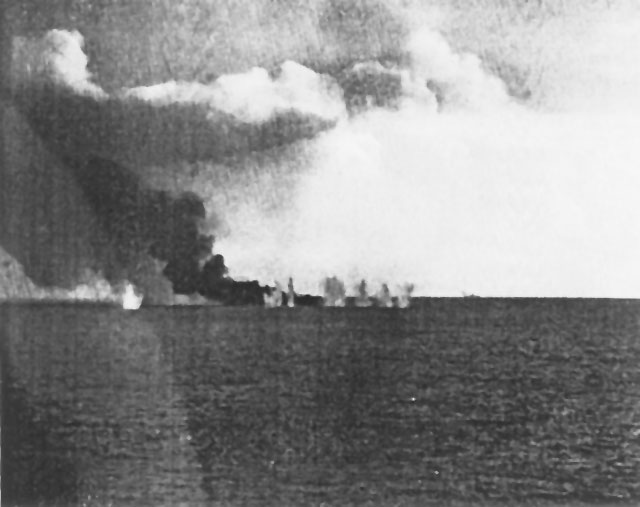
An 8-inch salvo from either Japanese cruiser Tone or Chikuma straddles the burning U.S. escort carrier Gambier Bay on October 25, 1944 during the Battle off Samar. The Japanese cruiser can be faintly seen in the center right of the photograph.
But the storm of fire from the escorts and the American planes cost the Japanese three heavy cruisers sunk, and three badly damaged. ADM Kurita, with victory within his grasp, took counsel of his fears. He recalled his force and attempted to make good his escape.
In just over two hours,the Japanese had inflicted 1000 fatalities upon Taffy 3, and sunk four ships.
But as historian Samuel Elliott Morrison notes his history of the battle, ADM Kurita’s failure was a very minor tactical victory when he should have inflicted a major operational defeat upon the US Navy. The IJN in October 1944 was a spent force. The role of the Center Force was a suicide mission. Had he persisted, he could have further battered Taffy 3, and far more importantly, he could have fallen amongst the invasion forces and done unimaginable slaughter to them.
While Taffy 3 escaped annihilation at the hands of ADM Kurita’s Center Force, it’s ordeal that day was far from over. Possibly the most fear inducing weapon the Japanese fielded in the war made its debut an hour later. For the first time, the Kamikaze corps would dive their planes to their doom, and their targets were the thin decks of the carriers of Taffy three. USS Kalinin Bay would suffer ghastly damage, and the USS St. Lo***, already badly damaged by gunfire, would succumb to a Kamikaze.
In the dark days of the summer and autumn of 1942 during desperate fighting in the Solomons Islands, US Navy ships, equipment, doctrine, leadership and training were often overmatched by their Japanese counterparts. Two years later, und
er some of the most trying circumstances imaginable, young sailors, many who had never been to sea before a few months before, performed magnificently, a feat of gallantry and bravery that has few, if any, rivals in US Navy history.Should you be interested in learning more of this battle, I strongly recommend Last Stand of the Tin Can Sailors by James D. Hornfischer, andSamuel Elliot Morrison’s The Two Ocean War.
*Now known as Taiwan
**In an historical oddity, the southernmost group was under RADM Thomas Sprague, no relation to Clifton
***USS St. Lo was originally commissioned USS Midway, but that name was “clawed back” for the CVB class carrier CVB-41. Sailors say it is bad luck to rename a ship.
-
Daily Dose of HOLY COW THAT’S A BIG SPLODEY!!!!
Spectacular angles of the same SVBIED detonating after being fired upon by Peshmerga MILAN ATGM. #Mosul pic.twitter.com/pUk1hmKfkh
— Afarin Mamosta (@AfarinMamosta) October 24, 2016
-
Oh, Say Can You See?
This is the most American goddamn thing I’ve ever see. Make sure you watch until the end. pic.twitter.com/FATDGdApR7
— Lachlan Markay (@lachlan) October 23, 2016
-
Rally
I enjoy NASCAR, and open wheel racing is exciting as well, but for sheer balls out driving skills, there’s nothing like rally racing.
-
USS Saluda
At the beginning of World War II, the US Navy, in spite of the massive Two Ocean Navy Act of 1940, was still critically short of ships of all kinds. As an interim measure, while the shipbuilding program spun up, the Navy bought or seized a large number of private vessels. The motor yachts of quite a few millionaires found themselves in grey paint, with a couple of obsolescent guns bolted on. For the most part, these were used as patrol vessels off the mouths of the great harbors of the East Coast.
One slightly surprising induction into the Navy was the sailing yacht Odyssey, taken into service early in 1942.
At 88 feet, and 92 tons, a yawl rigged sailboat might seem a bit odd for a choice as a warship. Nevertheless, she was commissioned into the US Navy as the USS Saluda (IX-87).
USS Saluda spent most of the war performing sound trials and hydroacoustic research in the ongoing effort to improve out fleet’s anti-submarine warfare capabilities. While the ship had a diesel auxiliary engine, the option to operate under sail power alone made for a very quiet platform, and a very handy test platform.
After the war, Saluda would make her way to San Diego, and serve for many years doing acoustic research for the Navy, eventually losing her status as a commissioned ship, and simply becoming a miscellaneous yard craft.
Eventually, in 1974, Saluda had outlived her usefulness, and was stricken from the Naval Register, and place for disposal.
At the time, my dad was CO of Naval Air Station Whidbey Island, WA. And some bright soul on the base staff noticed the listing for disposal. When government equipment is listed for disposal, government agencies get first dibs on it. And so, this bright person suggested that NAS Whidbey should snap up Saluda, and let her be used by Morale, Welfare and Recreation as a pleasure craft.
The only real challenge was finding a sailing qualified Coast Guard licensed master. Soon enough, one stepped forward, and with a couple of deckhands, proceeded to sail Saluda from San Diego to the Seaplane Base at Whidbey, where she moored at the long pier built to support the fuel barges that supply the base with jet fuel.
For very reasonable rates, groups, such as say, a Prowler squadron, might rent the Saluda for a day cruise, or a weekend in the beautiful San Juan Islands just north of Whidbey Island.
She was a beautiful ship, and still had aboard most of her luxury fittings from her first incarnation as a yacht.
Sadly, after four years, the costs of maintaining her, coupled with the departure of her licensed master, meant the time had finally come for the Navy to divest itself of the old girl.
But her days of sailing were not over. This time, when she was listed for disposal, she was snapped up by the Sea Scouts, and to this day, sails under her original name, as the Sea Scout Ship Odyssey out of Tacoma, Washington.
-
Thousands of soldiers forced to repay enlistment bonuses a decade after going to war – U.S. – Stripes
WASHINGTON (Tribune News Service) — Short of troops to fight in Iraq and Afghanistan a decade ago, the California National Guard enticed thousands of soldiers with bonuses of $15,000 or more to reenlist and go to war.
Now the Pentagon is demanding the money back.
Nearly 10,000 soldiers, many of whom served multiple combat tours, have been ordered to repay large enlistment bonuses — and slapped with interest charges, wage garnishments and tax liens if they refuse — after audits revealed widespread overpayments by the California Guard at the height of the wars last decade.
Investigations have determined that lack of oversight allowed for widespread fraud and mismanagement by California Guard officials under pressure to meet enlistment targets.
But soldiers say the military is reneging on 10-year-old agreements and imposing severe financial hardship on veterans whose only mistake was to accept bonuses offered when the Pentagon needed to fill the ranks.
“These bonuses were used to keep people in,” said Christopher Van Meter, a 42-year-old former Army captain and Iraq veteran from Manteca, Calif., who says he refinanced his home mortgage to repay $25,000 in reenlistment bonuses and $21,000 in student loan repayments that the Army says he should not have received. “People like me just got screwed.”
via www.stripes.com
Ouch.
Makes me kinda grateful I never received any reenlistment bonuses.
-
DART motorcycle officer seriously hurt in crash – Story | KDFW
DALLAS – A Dallas Area Rapid Transit officer was injured while on duty Monday night.
Officer Justin Ellis was seriously injured when a driver ran a red light and hit his motorcycle on Scyene Road near Fair Park in Dallas.
via www.fox4news.com
Officer Ellis is the brother of a longtime friend and occasional contributor to the blog.
Your prayers and good thoughts for his recovery would be very welcome.
-
World of Warships- Kitwar seizes the initiative
Sometimes, it’s not all about how many ships you sink, but about how you lead your team.
-
Trafalgar
On this day in 1805, Admiral Lord Nelson lead the British fleet to a stunning victory against the French at Trafalgar, an fell in battle, securing his his place in history.
-
Inside Wargaming.net and Games That Conquered the World – Rolling Stone
Two decades later, Kislyi's twin obsessions with military history and strategy games have made him a billionaire. His company Wargaming.net has a highly lucrative line of accessible, historically accurate MMO combat games. It isn't just the largest game publisher to emerge from the former Eastern Bloc – it's one of the most popular and profitable publishers in the world.
Wargaming.net's line of "freemium" PC titles – World of Tanks, World of Warplanes and World of Warships – have 150 million registered players who purchase over four million in-game items every day. The most expensive are authentic recreations of vintage military hardware: A rocket-powered Japanese J8M interceptor aircraft for $54.99, a 1930s Leningrad-class Soviet destroyer for $25.99 or a WWII-era British Black Prince tank that never made it past the prototype phase for $10.49.
A bit of backstory on Wargaming.net, creators of World of Warships.
Nick Moran, noted later in the article, has a great series of videos on YouTube, and I encourage you to subscribe.
-
Subscribe
Subscribed
Already have a WordPress.com account? Log in now.
 XBradTC