-
Wednesday Matinee-The Enemy Below
Robert Mitchum and Curt Jurgens face off in this classic cat and mouse story of the U-boat war. This one has Korean subtitles, but it looks great, sounds good, and after a few minutes, you don’t even notice the subtitles.
Heh. SUB-titles.
Get it?
-
Army: Bergdahl reports are untrue, no decision made
The Army says there is no truth to media reports claiming a decision has been made to charge Sgt. Bowe Bergdahl with desertion.
The Army continues to review the case against Bergdahl, said Paul Boyce, a spokesman for Forces Command, on Tuesday morning.
“Sgt. Bergdahl has not been charged with any crime,” said Pentagon Press Secretary Rear Adm. John Kirby during a press briefing Tuesday afternoon.
via Army: Bergdahl reports are untrue, no decision made.
There’s a reason I didn’t jump on reports about this last night. Until charges are in fact announced, patience is a virtue.
As far as I know, SGT Bergdahl isn’t under any form of restriction, and is reporting for duty much as any other soldier would, though I seem to recall that his place of duty is pretty much the Army equivalent of stashing him in a broom closet. He is receiving pay and allowances commensurate with his grade and time in service, and presumably receiving the same weekend passes as other soldiers.
None of which bothers me in the least.
First, the burden here, should charges be brought against SGT Bergdahl, is upon the government. And while you and I *think* he deserted, proving such in a court martial might be somewhat more difficult that just tapping into public opinion. If the powers that be want to take their time, that’s fine with me. And that brings me to my second point…
You’ll notice ONE thing that hasn’t happened to SGT Bergdahl is processing for discharge at the completion of his initial term of service, what we in the Army usually call ETS. There’s a provision of the Army regulation covering discharges that pretty much says, if for reasons of convenience of the government, they wish to keep you on active duty indefinitely, they may do so (I’m way too lazy/busy to look up the exact provision of AR 600-whatever the hell it is).
I don’t know the term of service for which SGT Bergdahl initially enlisted, but he’s doubtless past his initial ETS date. And if he’d voluntarily reenlisted, I suspect we’d have heard that. So that leaves his continued presence on active duty as convenience of the government.
-
The Liberation of Auschwitz

-
BBC News – Greek fighter jet crashes in Spain killing 10 people
Ten people have died in a fighter jet crash at a military base in Spain, the Defence Ministry says.
Military officials said that the Greek F-16 jet crashed into other planes and exploded at the Los Llanos airbase in Albacete in central Spain.
One of the pilots performed a wrong manoeuvre during take-off, according to local media. Both pilots were killed.
Another 13 people have been injured, six of them seriously, according to officials.
via BBC News – Greek fighter jet crashes in Spain killing 10 people.
Simply awful.
We’ll have to wait to see the cause.
-
Coast Guard SAR in action
Here’s a textbook example of the Coast Guard executing a long range Search and Rescue mission to save the life of an aviator in distress.
Yesterday, a Cirrus SR-22 with an auxiliary fuel tank installed was being ferried from California to Hawaii. This is a fairly routine procedure. In this case, however, it appears that a fuel transfer valve malfunctioned, and the pilot quickly realized he would be unable to reach his destination with the remaining available fuel. A quick calculation showed he would run out of fuel about 230 miles short of land.
A Mayday call to the Coast Guard led to the dispatch of a Coastie HC-130 Search and Rescue plane. The Herc served as the on scene coordinator. It located a cruise ship in the vicinity of the anticipated splashdown point, and provided* navigational assistance to both parties.
The SR-22 has an installed parachute recovery system that allows it to deploy its parachute in the event of engine failure or other emergency.
*That’s actually supposition on my part. Call it informed speculation.
-
A Stealth Flyover at the Pro Bowl.
Four F-35A conventional take off and landing models, based at Luke AFB, will fly over the University of Phoenix Stadium around 6 PM local time to kick off the game. Chances are it will coincide with the national anthem, as these flyovers tend to do.
For aviation watchers, it will be a rare chance to see the F-35 flying in front of a crowd. For the service, it could be a chance to show that their oft-criticized jet is actually flying as it inches closer to going operational.
via [UPDATED] F-35 Flyover Planned for Pro Bowl.
The Air Force did a bit of hyping about the four F-35A Lightning II jets performing a flyover for the start of the Pro Bowl.
The problem was, none of it was televised. Apparently none of the video cameras for the game bothered to look up and show the roughly billion dollars worth of aircraft cruising sedately overhead.
Indeed, on twitter, there was some speculation it simply didn’t happen. Or, the wags posited, the F-35s stealth is a lot more capable than anyone suspected!
But it did, in fact happen.
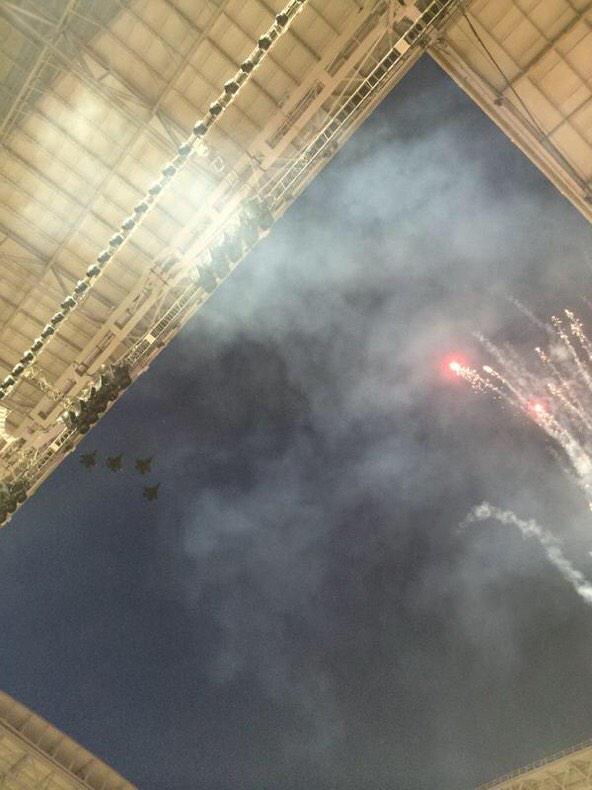
Of course, attendees only get a glimpse in this sort of semi-covered stadium.
The Air Force at least had the sense to get some exterior video.
-
Veti-Gel, the future of trauma first aid?
-
PLA Navy tests new refueling pod for J-15 carrier fighter|Politics|News|WantChinaTimes.com
Having successfully copied the Russian-built UPAZ-1A aerial refueling pod, China’s PLA Navy can refuel a J-15 carrier-based fighter in midair in 5.3 minutes, the Moscow-based Center for Analysis of Strategies and Technologies said on Jan. 22.
via PLA Navy tests new refueling pod for J-15 carrier fighter|Politics|News|WantChinaTimes.com.
Spill’s on a bit of an air-to-air refueling history kick right now, so I thought I’d share this. Carrier aircraft almost inevitably use probe and drogue refueling. Our land based friends tend to use boom and receptacle, because it was designed for large bomber type aircraft. Booms also have much higher fuel transfer rates. But they require a large dedicated tanker, such as the KC-135. Obviously, you can’t fit one of those on a carrier. So probe and drogue it is.
There’s primarily two types of tanking in naval air, mission tanking, and recovery tanking. Mission tanking is used to extend the endurance or range of strike aircraft for a given mission. Recovery tanking is simply topping off returning aircraft to give them more time to land aboard ship, for instance, if the recovery is delayed by a foul deck or the pilot is having his turn in the barrel and repeatedly boltering (failing to arrest during his landing).
The US Navy used to have dedicated KA-3B and KA-6D tankers in its air wings, which carried sufficient fuel to perform both tanking missions pretty well. Today, the tankers of the air wing are simply F/A-18 E and F SuperHornets that have a buddy refueling pod slapped on. The long, long flights required to support operations in Afghanistan, Iraq and a few other places also means the Navy has increasingly had to rely on tanker support from the Air Force for mission tanking. KC-135s have an adapter to put a basket on the end of their boom.
Tanking is, like landing upon a carrier, one of those incredibly difficult feats of airmanship that naval aviators simply must become proficient in as a matter of routine, or they are useless to the fleet.
For the Chinese, this is especially so. The ski-jump take off they use on their carrier greatly limits the gross weight a fighter can take off with. If the fighter is going to carry a useful load of weapons, that means much less than full fuel can be carried. Hence the need for a refueling pod. Just how much one J-15 (essentially a Chinese carrier capable version of the Russian Su-33) can transfer is an open question. But a little bit of giveaway fuel is a whole lot better than none.

UPAZ-1A Refueling pod under Russian Su-24. Presumably the Chinese derivative is similar in appearance.
-
A Century of Service in the Russian Navy.
Spill pointed this tidbit to me. The Russians operate a submarine tender/salvage ship that has been in commission since 1915!

English Russia also has a great collection of photos of the Kommuna.
-
DUKW!
From requirement to prototype in 38 days, and placed into production with only minor changes throughout the run.
In the very early days of World War II, as the Army grasped that it would be required to conduct major amphibious assaults in virtually every theater it deployed to, it also realized that the real challenge wouldn’t be getting forces ashore, but rather sustaining them with supplies over the assault beaches until port facilities could be captured. The plan was to use the same landing craft that lifted the assault troops to haul supplies. The trouble there was that transferring cargo from beaching craft to trucking ashore was time and manpower intensive. And so, the National Defense Research Council had a flash of brilliance. Why not build an amphibious truck?
The respected yacht designers of Sparkman and Stephens sat down with GMC, and quickly produced a prototype. Taking a variant of the recently introduced CCKW 6×6 2-1/2 ton truck, they added a sealed buoyant hull, a propeller and rudder, and viola! the amphibious truck was born. Under the GMC naming convention of the time, D stood for designed in 1942, U for amphibious, K for all-wheel drive, and W for dual rear axles. Hence, DUKW, which quickly became to the GI tongue, the Duck.


The DUKW was a surprisingly seaworthy truck, and much faster on land than any other boat. About 21,000 were produced by 1945, and served in the US Army and the Marines in just about every theater after North Africa.
Interesting tidbit. The documentary interviews Marines that operated DUKWs. In the Army, most were operated by African American soldiers in segregated units. The invasion of Iwo Jima is pretty much considered an all Marine Corps show, but Army Amphibian Truck Companies including the 476 ATC supported the operation, with its soldiers earning five Silver Stars and seventeen Bronze Stars, as well as the company being awarded a Navy Unit Commendation. That’s a hell of a record for a transportation company.
Over the years, many DUKWs have found their way through surplus sales into civilian hands, and they popular tour boats in places such as the Wisconsin Dells. That hasn’t been without risk. The sinking of a DUKW in Arkansas in 1999 cost 12 lives due to poor safety measures in place.
Still, the DUKW design was remarkably sound, given the time it took to develop, and was an extremely valuable tool in the amphibious operations of the war.
-
Subscribe
Subscribed
Already have a WordPress.com account? Log in now.
 XBradTC