-
The Death of Ernie Pyle
Stoop shouldered 44 year old correspondents aren’t normally an object of admiration and love for grunts. But World War II newsman Ernie Pyle was, undoubtedly, the exception.
While most correspondents covered the headquarters, the big picture, Ernie covered the dogfaces, the grunts, from North Africa to Italy, and from France to the far reaches of the Pacific.
He earned the Pulitzer Prize for his writing, his empathy for the hardships the average American soldier faced. He showed the humanity of the troops in that most inhumane arena, war.
Probably his best known column was The Death of Captain Waskow.
AT THE FRONT LINES IN ITALY, January 10, 1944 – In this war I have known a lot of officers who were loved and respected by the soldiers under them. But never have I crossed the trail of any man as beloved as Capt. Henry T. Waskow of Belton, Texas.
Capt. Waskow was a company commander in the 36th Division. He had led his company since long before it left the States. He was very young, only in his middle twenties, but he carried in him a sincerity and gentleness that made people want to be guided by him.
“After my own father, he came next,” a sergeant told me.
“He always looked after us,” a soldier said. “He’d go to bat for us every time.”
“I’ve never knowed him to do anything unfair,” another one said.
I was at the foot of the mule trail the night they brought Capt. Waskow’s body down. The moon was nearly full at the time, and you could see far up the trail, and even part way across the valley below. Soldiers made shadows in the moonlight as they walked.
On this day in 1945, Ernie Pyle was accompanying officers of the 77th Division during a “minor” operation to seize the island of Ie Shima, near Okinawa. A concealed Japanese machine gun nest fired upon the group. The four men dove into a ditch. Pyle, raising his head to check on the others, was struck in the left temple by a second burst of fire, and killed instantly.

-
Saturday Matinee- The Longest Day
A classic movie, that spawned the phrase “…and a cast of thousands.”
How can you not love a movie with John Wayne, Robert Mitchum, Henry Fonda and Sean Connery?
H/T War News Updates.
-
Bits and Pieces
From the mailbag:
“You know all the homeless vets we see out there on the streets? Half of them are just 2LTs that got lost on a Land Nav course.”
Thanks, LT Rusty.
———
The Army faces a morale problem:
More than half of some 770,000 soldiers are pessimistic about their future in the military and nearly as many are unhappy in their jobs, despite a six-year, $287 million campaign to make troops more optimistic and resilient, findings obtained by USA TODAY show.
Twelve months of data through early 2015 show that 403,564 soldiers, or 52 percent, scored badly in the area of optimism, agreeing with statements such as “I rarely count on good things happening to me.” Forty-eight percent have little satisfaction in or commitment to their jobs.
The results stem from resiliency assessments that soldiers are required to take every year. In 2014, for the first time, the Army pulled data from those assessments to help commanders gauge the psychological and physical health of their troops.
Well no kidding. Faced with slashed budgets and personnel cuts, and uncertainty, troops are going to be a tad stressed. Further, the social engineering that civilian leadership insists upon isn’t helping. Finally, computer based training and mandatory surveys such as this are universally despised, so making PFC Joe Snuffy take the survey, and inviting him to bitch, is virtually guaranteed to elicit a negative response.
That’s not to say there aren’t morale issues, but don’t panic just yet.
——–
An update on Brazil’s C-1A Trader modernization. Brazil wants to use them as COD and as tankers for their airwing.

———
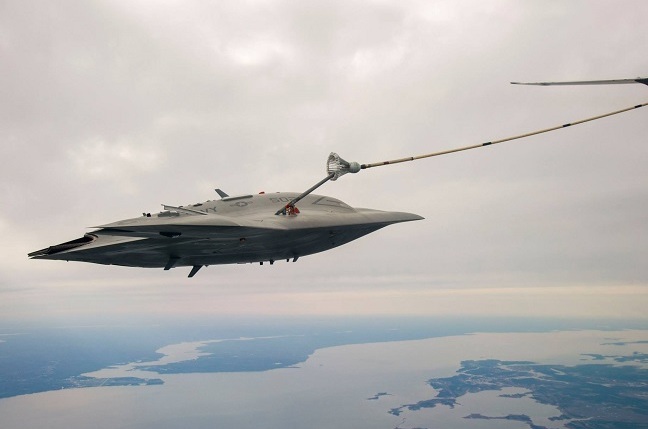
The X-47B managed to plug a tanker.
———
More to come.
-
Your Weekend Reading Assignment- The ONI Assessment of the People’s Liberation Army Navy
The Office of Naval Intelligence has issued an assessment of the Chinese Navy (often referred to as PLAN) as well as its various Coast Guard type quasimilitary adjuncts.
Here’s some helpful graphics showing ship classes as well.
One more.
There’ll be a quiz shortly after Load HEAT on Monday.
H/T to Spill
-
Sailor Hat
We’re on a bit of a nuclear weapons kick. This is actually a post that is about nuclear weapons, but doesn’t contain any.
After the Partial Test Ban Treaty, above ground nuclear explosions, including those in the ocean that would broach the surface, were prohibited.
In the meantime, the US Navy was rapidly running out of surplus World War II ships to upgrade, and was designing several classes of ships such as the Leahy class anti-air escorts using aluminum superstructures to save weight. Further, the array of antennas and other ancillary equipment on US ships was growing. But the Navy lacked empirical data on how such structures and arrays would fare in the blast overpressure regime of a nuclear weapon. What to do? Well, obviously, the thing to do was to generate blast overpressure. But since nukes were out, that meant something else was needed. What the Navy eventually did , in 1965, was stack a dome of 500 tons of high explosives along the shore of an uninhabited island in Hawaii, and blow it up, with ships nearby. Not once, but three times!

The prime target was the former light cruiser Atlanta. She was taken into the yard, had her superstructure razed, and new deckhouses erected using the design, materials and standards then in use for new construction. Further, representative radar arrays of just about every type in use in the fleet were added to her deck. She had two bridges, one replica of a frigate/missile cruiser bridge forward, and a guided missile destroyer bridge aft.

While the former Atlanta was positioned closest to the blast, and was intended to actually sustain damage, other ships were also present, to validate the data. And not just target hulks, but actual, modern, in service ships, equipped with the same superstructures and sensors the test was designed to challenge. Further, the ships were fully manned by their regular crews.
Sailor Hat is pretty well documented. 10psi overpressure was quite damaging to ships, as you can see in the video.
Now, 500 tons of explosives is quite a bit. But it’s not even close to the biggest charges.
In the 1980s, two other programs tested massive conventional charges as substitutes for nuclear weapons. Operation Minor Scale set off 4,000 tons (that is, four kilotons) of conventional explosives. As the press release wryly noted, there were no plans for Operation Major Scale. Minor Scale represented the expected blast overpressure and ground wave effects of roughly an 8 kiloton airburst weapon, roughly half the power of the Hiroshima bomb. Similarly, Operation Misty Picture set off about 4,600 tons of explosives

While neither Minor Scale nor Misty Picture are classified, and indeed reporters were present at Minor Scale, very few pictures have been released, and to date, no video, likely because of sensitive technical aspects of the measurement arrays for the tests.
-
Operation Crossroads
We posted yesterday about researchers finding the former USS Independence, a light carrier that had served in World War II, and was later a target vessel used in atomic testing. She actually survived not one, but two atomic blasts, with considerable damage, but no loss of hull integrity. She was scuttled primarily because decontaminating her proved to be too difficult.
Immediately after World War II, the US realized it had the ultimate trump card in the atomic bomb, but was surprised to find just how little it knew about what the weapons could, and more importantly, could not, be expected to do to targets, particularly military targets. The Navy especially was concerned about what effect nuclear weapons would have on the future of naval warfare. Scientists as well needed to conduct research into the basics of weapon development. They had very little information to work with, as only three devices had ever been detonated, and rather obviously, very little scientific data was available from the two used in combat.
And so, even as the US was working to build an inventory of nuclear weapons, it chose to expend two in a test program at Bikini Atoll in the Marshall Islands. Further, the Navy arranged a target array of about 90 of virtually every type at varying ranges from the intended ground zero. The first weapon, Able, was an airburst, dropped from a B-29. The second shot, Baker, was a shallow underwater burst, with the device suspended by cables from a small ship.
Grab a cup of coffee, this is going to take a bit. The first video is quick, and shows the Baker shot in color.
This video is about 42 minutes long, and shows the set up and effects of both Able and Baker.
What’s astonishing is just how few ships were actually sunk. Ships only a few hundred yards from the burst survived with relatively little damage. The Able shot, being an airburst, left relatively little fallout. The Baker shot, however, was a radiological mess, heavily contaminating virtually every ship in the array.
The major wrecks at Bikini, Saratoga, Nagato, etc, are in quite shallow water, and can be dived with regular scuba equipment.
-
Scientists find radioactive aircraft carrier off San Francisco coast – News – Stripes
HALF MOON BAY, Calif. (Tribune Content Agency) — In a ghostly reminder of the San Francisco Bay Area’s nuclear heritage, scientists announced Thursday they have captured the first clear images of a radioactivity-polluted World War II aircraft carrier that rests on the ocean floor 30 miles off the coast of Half Moon Bay.
The USS Independence saw combat at Wake Island and other decisive battles against Japan, and was later blasted with radiation in two South Pacific nuclear tests. The Navy deliberately sunk the contaminated ship in 1951 south of the Farallon Islands.
via Scientists find radioactive aircraft carrier off San Francisco coast – News – Stripes.

The Independence survived not one, but two nuclear blasts. Able was an airburst, and Baker was an underwater detonation. The Independence wasn’t sunk, or even really that badly compromised by either. The real problem was that the base surge of contaminated water from Baker made her far too hot, radioactively speaking. So the Navy simply towed her out a short bit from San Francisco Bay and sunk her.
-
More on that F-15 Mishap, and the Radome Cap.
As usual, no single factor is responsible for the loss of an aircraft. Here’s the report, with some analysis on how such a minor aerodynamic blemish could have such a major impact.
-
Daily Dose of Splodey
Space-X came this><close to successfully recovering the first stage of a Falcon 9 used just minutes earlier to launch a Dragon capsule into orbit.
Word is that Space-X, having demonstrated successful control of the vehicle in all phases except touchdown, will forego the barge based landing pad and attempt to land ashore next time.
By the way, while they haven’t successfully recovered a first stage that’s actually been used in a launch, they have successfully made ascents and landings during testing prior to these attempts.
-
JOINT CHIEFS: Why We Don't Care That You're Resigning
The following is an opinion article written by the members of the Joint Chiefs of Staff.
It has come to our attention that another company grade officer has very publicly resigned, citing numerous reasons for doing so. As the top commissioned leaders of the different branches, we feel this issue now requires that we respond to these resigning officers.
First and foremost, thank you for your service. Most Americans will never understand what can be gained from putting yourself at a point of great friction in defense of your nation’s way of life. We are truly grateful for the countless sacrifices every one of our servicemembers makes, especially the ones that will never be perceived at our level. We know that this is a hard life, and it hurts us to know that there are good things you do that will never be recognized.
Second, we do not care that you are resigning. Your career is less than a blip on our radar screen. Your skills and experiences will never in a million years cause us to raise even a finger to stop you from resigning, much less cause us to look back on your resignation with regret. Regardless of your unique and valuable perspective, you could not be more replaceable.
via JOINT CHIEFS: Why We Don’t Care That You’re Resigning.
TDB is our go-to for military laughs. But this piece is absolutely serious, and spot on. Go read the whole thing.
-
Subscribe
Subscribed
Already have a WordPress.com account? Log in now.
 XBradTC