-
Future Warfare: The X-47B | RealClearDefense
Pentagon leaders often speak of the need for disruptive technologies in the Fleet to mitigate the risks of shrinking defense budgets, declining U.S. military technological superiority and improving adversary capabilities. Last week, a remarkable example of disruptive innovation occurred. How did the Navy react? It simply reaffirmed its unimaginative plan to send its carrier-launched drone to the boneyard—and potentially sentence the aircraft carrier to a similar fate.
The Navy’s test carrier drone, the X-47B UCAS-D (Unmanned Combat Air System Demonstrator), recently participated in the first-ever fully autonomous aerial refueling at Naval Air Station Patuxent River. Though the implications of this engineering feat are wide-ranging and not wholly known at this point, successful demonstration of unmanned aerial refueling does shed light on several ongoing arguments about the future of U.S. military aviation.
via Future Warfare: The X-47B | RealClearDefense.
We’re always hesitant to match wits with Mackenzie and Bryan, two very smart people, who make a living at this sort of thing.
But we wish to remind them, and you, dear reader, that the X-47B was just what its name says, a demonstrator. That is, it was specifically designed and engineered to demonstrate five capabilities. First, autonomous flight. Second, operations on the flight deck of an aircraft carrier. Third, launch from an aircraft carrier’s catapults. Fourth, the ability to land on an aircraft carrier. Finally, to autonomously conduct aerial refueling.
It has done all five tasks, though let us note that each was done in near perfect conditions, and not the worst case scenarios of weather or other operational environments that any fleet platform would face.
But that is all the X-47B was designed to do. The leap from a technology demonstrator to a deployable combat assets is vast.
We would remind Mackenzie and Bryan of the X-35 JSF demonstrator, a platform visually almost indistinguishable from the F-35 fighter. The X-35 was a technology demonstrator as well. It first flew in 2000. Here we are a decade and a half later, and its progeny, the F-35, is still not quite to its Initial Operational Capability.
There is a growing fight within the Naval Air community over what the operational UCLASS (Unmanned Carrier-Launched Airborne Surveillance and Strike) platform should focus on. There is a strong school of thought in NavAir that the emphasis should be on the surveillance part, not the strike part. That puts them at odds with people like John McCain, who’s powerful position on the Senate Armed Services Committee gives him an outsized voice on what is to come. McCain and others see little point to a platform that isn’t designed to address anti-access/area denial threats from China and other potential adversaries.
Those threats are very much in the mind of the folks at NavAir. Their argument is that a surveillance focus is technologically feasible now, and the design and operational deployment of such a platform would be relatively quick and painless. And that operational deployment would provide the real world experience and lessons learned that would made future evolutionary strike variants much more likely to be successful, all while addressing one of the critical shortcomings of today’s Hornet centric airwing.
We tend to side with the less ambitious crowd arguing for a surveillance emphasis.
-
The Best Corporate Response to a whining SJW I’ve ever seen.
So, a company called Protein World started using this ad.

And of course the Feminist SJWs got the vapors. Which, Protein World, rather than engaging in endless self abasement, stood firm.

Grow up, Harriet.
-
Drone Warfare- Before Predator
Old folks, people my age, remember just how bizarre it was that Predator drones in Afghanistan and Iraq began carrying and using Hellfire missiles to target high ranking terrorists. It seems pretty revolutionary to conduct remote control warfare.
But it isn’t as though the idea had never occurred to anyone before.
During the Vietnam War, one of the most challenging, dangerous missions was that of the Wild Weasels. Tasked with suppressing the radars and missile launchers of SA-2 Guideline SAM batteries, modified F-105F and F-105G fighter bombers played a deadly game of cat and mouse with the radar operators of the People’s Army of North Vietnam.
The losses among Weasels were always high, and bright minds wanted to find a way to reduce the risk to aircrews. Someone in the Air Force noticed that Ryan Firebee drones routinely had to be augmented with radar reflectors and thermal flares to accurately portray fighter sized aircraft, in terms of radar returns. It made sense then, that if these features were removed, it would be somewhat difficult to actually track the Firebee drones, say, by the Vietnamese. Firebee drones had routinely been used as reconnaissance assets over North Vietnam. The next logical step was to arm them to attack SAM batteries, thus keeping Weasel crews out of the worst of the danger, while still suppressing the SAMs enough to allow the main strike packages to reach their targets.
There’s a couple of nice splodeys in there.
To the best of my knowledge, this capability was never used operationally. But ever since Vietnam, there has been intense interest in less conventional methods of suppressing enemy air defenses. One wonders what secrets in the field are still to be revealed.
-
Russian Rehearsal for 70th Anniversary of VE Day Parade
The Russians are always big on big parades of military hardware. And the 70th anniversary of Victory in Europe Day is a fine excuse for a parade. And of course, the military being the military, they have to hold a rehearsal.
I thought adding in the T-34 tanks was an especially nice touch.
By way of contrast, you’ll notice the US pretty much never does anything like this. Can you imagine the 1st Armored Division rolling through DC just to show off?
-
Centennial of ANZAC Landings at Gallipoli
Today marks another significant centennial of the Great War. (Yesterday marked the centenary of beginning of the Armenian Genocide.) The ANZAC landings at Gallipoli took place on 25 April 1915. It is a very special ANZAC Day. From last year:

Today is the 25th of April. It is ANZAC Day, commemorating the 99th anniversary of the landings of 31,000 men of The Australian Division, and the Australian-New Zealand Division (reinforced with two batteries of mountain guns) on the crescent-shaped portion of beach known as Ari Burnu, forever after known as Anzac Cove.

The ANZAC landing began before dawn on 25 April 1915, and was initially unopposed, By mid-morning, however, Turkish troops under LtCol Mustapha Kemal had reacted strongly and taken the landing beaches and the precariously shallow Dominion positions under rifle, machine gun, and artillery fire. Unable to move forward, and hanging onto hillside rocks and scrapes, ANZAC Commander MajGen Sir William Birdwood asked to have the beach-head evacuated.

The Royal Navy argued that such an evacuation, particularly under fire, was impractical. So Birdwood was ordered to stay, with the advice given by General Sir Ian Hamilton to “dig, dig, dig!”. It is from this message, many conclude, that the ANZACs became known as the “diggers”. Despite herculean efforts and near-suicidal courage, including the tragically costly landings at Sulva Bay in August of 1915, the stalemate was never broken. Unable to advance, with no evacuation possible, the ANZACs remained locked in their initial positions, enduring conditions even more horrendous than those on the Western Front, until finally pulled out as a part of the general evacuation of the Gallipoli Operation in December of 1915.

ANZAC Day has become a day of remembrance for all Australian and New Zealand war dead, but remains especially poignant for the nearly 13,000 Australian and New Zealand soldiers who gave their lives in the foothills of the Bari Sair Mountains, in the eight months of hell on Earth that was Anzac Cove.
At the going down of the sun,
and in the morning,
we will remember them.
army, Artillery, engineering, guns, history, infantry, leadership, logistics, navy, Russia, ships, Uncategorized, veterans, war, weapons -
Building the DEW Line
Four years ago, we wrote about the role of the Distant Early Warning Line, or DEW Line, in the continental air defense of North America. As it turns out, the prime contractor, Western Electric, commissioned a PR film to tout their achievement. It’s incredible the challenges they faced, and amusing and even inspiring the often brilliant ways they overcame those same challenges.
-
A little more on the S-300 Missile System
I kinda posted that post the other day before I was finished. Ace had a post up on some of the political aspects of it, and I wanted to get my post up on his sidebar. Because I wanted the traffic. I think I hit most of the actual high points of the system itself, but there are a few other things worth noting.
First, the S-300P’s basic architecture and missile form the basis of the Russian Navy’s premiere shipboard Surface to Air Missile system, the S-300F, or as it is known by its NATO reporting name, the SA-N-6 Grumble. The SA-N-6 uses the earlier 5V55RM missile, rather than the newer, higher performance 48N6 missile. One Kirov class battlecruiser has the improved missile, but the other two are in mothballs and have not been upgraded. In addition to the Kirov’s, Slava class cruisers carry the Grumble.
News of the pending export of S-300P to Iran would leave you to believe that this is some new and unusual step. In fact, the S-300P family has been fairly widely exported, and licensed for production elsewhere. In addition to widespread use in the former Warsaw Pact nations, it is used by Greece, Venezuela, and Egypt.
The largest export customer is China, who operate both large numbers of the S-300P system, and locally produce a slightly modified version as the HQ-9 series, as well as the HHQ-9 as the primary long range SAM for new construction surface warships.


-
Fourth X-37B flight a month away from launching | Spaceflight Now
CAPE CANAVERAL — The U.S. Air Force on Friday made its first public confirmation that the X-37B unmanned space shuttle will be launched next month on the fourth flight of an Orbital Test Vehicle.
“We are excited about our fourth X-37B mission,” said Randy Walden, the director of the Air Force Rapid Capabilities Office. “With the demonstrated success of the first three missions, we’re able to shift our focus from initial checkouts of the vehicle to testing of experimental payloads.”
The Air Force said its Rapid Capabilities Office had collaborated with several partners to test “new experiments on this fourth flight for the X-37B program.”
via Fourth X-37B flight a month away from launching | Spaceflight Now.
Roamy pointed this out to me.
What’s interesting is that beyond the fact that they’ll launch the thing, there’s really no information in this press release. No idea what it will be doing up there (beyond vague propulsion stuff) or how long it will be up there, or why use the X-37, and not some other platform.
Tis a riddle, wrapped in a mystery, wrapped in an enigma.
-
Family Time
I’ve got family visiting. With a little bit of luck, maybe one of the coauthors has something to post.
If not, I’mma try to do a brief follow up on the S-300 post later tonight.
In the meantime, The Who >Rolling Stones>the Beatles. Discuss.
-
Texas A&M football team goes through Navy SEAL training | | Dallas Morning News
If Texas A&M head football coach Kevin Sumlin was looking for an alternative way to bring his players together, he may have found the perfect way to do just that on Thursday.
A&M assistant coaches posted pictures to their personal Twitter accounts on Thursday of Aggie football players doing similar training to what Navy SEALs or Marines go through.
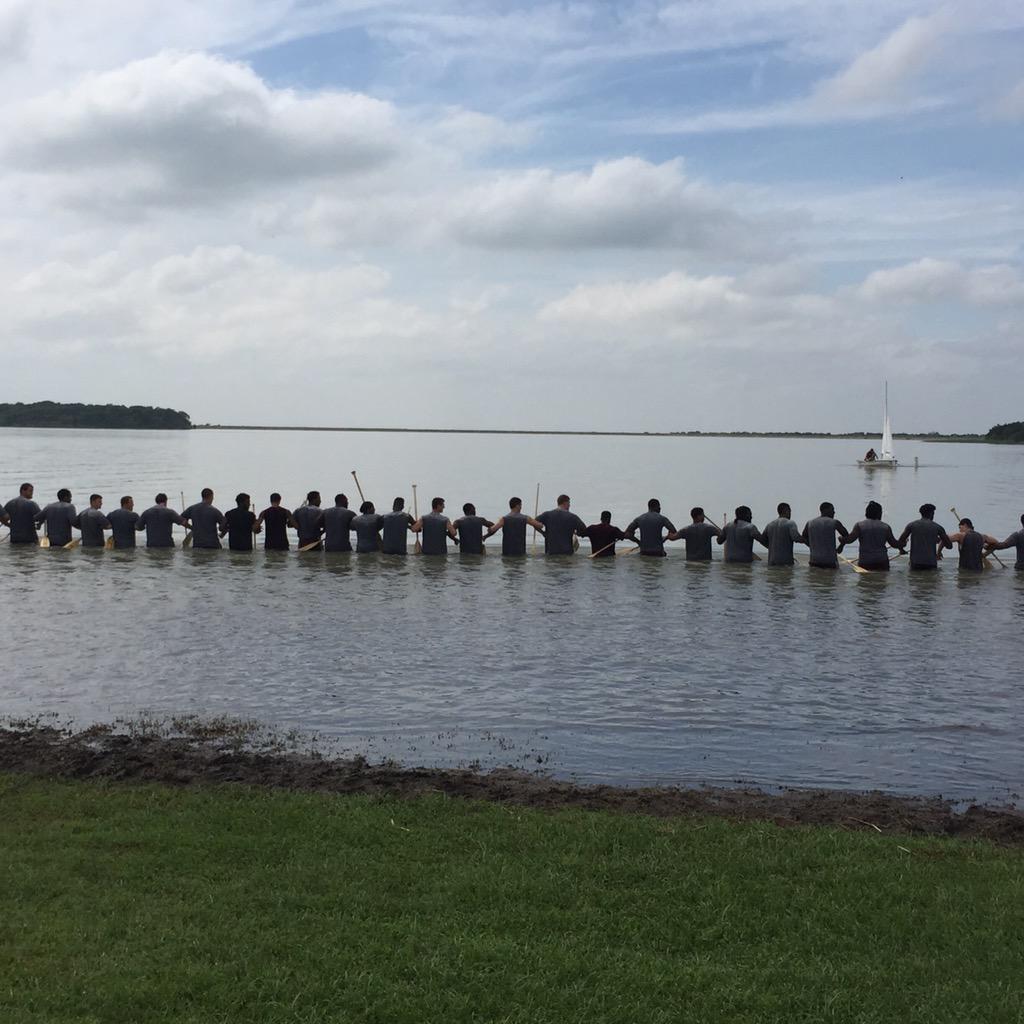
via Texas A&M football team goes through Navy SEAL training | | Dallas Morning News.
It’s not quite the real deal (for one thing, it’s run by the A&M Corps of Cadets, and not the Navy) but it’s still an excellent team building exercise.
I should note that I’ve done enough rubber boat training to know it isn’t always fun.
I should also note that the closest I’ve come to *real* SEAL training is sitting on my balcony in VIP quarters at NAB Coronado while sipping a cocktail and watching the young sailors going through BUDS make sugar cookies in the sand and run back and forth into the surf.
A tip o’ the hat to Aggiesprite, who might just be a tad biased toward A&M.


-
Subscribe
Subscribed
Already have a WordPress.com account? Log in now.
 XBradTC