-
The Associated Press Has Found Their Narrative

Really guys?

-
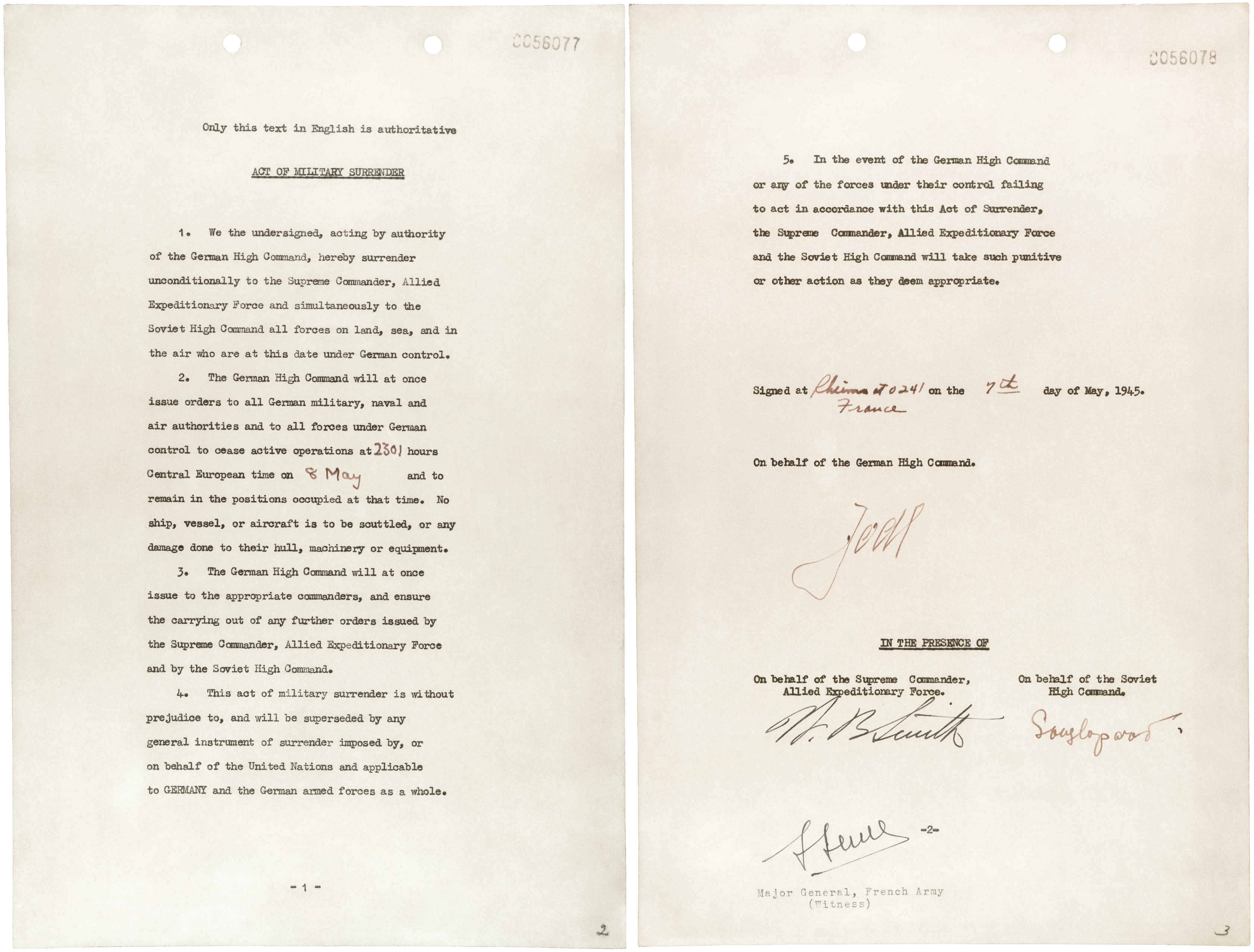
“The mission of this Allied Force was fulfilled at 0241, local time, May 7th, 1945.”
That message, sent 70 years ago by General of the Army Dwight D. Eisenhower, Supreme Commander, Allied Expeditionary Forces Europe, to the American and British governments, signaled the end of World War II in Europe.

Alfred Jodl would sign the instruments of surrender for Germany at Rheims.

On May 8, a similar instrument was signed in Berlin, ending the war with the Soviet Union. The US and most western nations celebrate Victory in Europe on May 8. The Russians celebrate on May 9.
On May 6, 1945, the focus of the entirety of the Allied forces in Europe was the defeat of Germany. On May 8, the focus was on getting out of the damn Army and getting home. It would take some time for that to pass, and indeed, to this day, Americans are stationed in Germany, though since 1955, as guests and allies of their former enemies.
Of course, the War in the Pacific remained to be won. But with the defeat of Germany, it was seen as a foregone conclusion that Japan would fall to the combined might of the Allies. There would be a great deal of death, destruction and suffering to come, but the end game was all that was left to play out.
More than 40 vintage aircraft of World War II will fill the skies over the nation’s capital Friday in tribute to the 70th anniversary of Victory in Europe (V-E) Day.
Fifteen flying formations will form up near Leesburg, Virginia, and follow the Potomac River southeast toward Washington. But unlike the usual “river run” of modern commercial flights into Reagan National Airport, the venerable war birds will bank over the Lincoln Memorial, overflying the National World War II Memorial, head east past the Washington Monument along Independence Avenue, turning south as they pass over the National Air and Space Museum near the Capitol.
-
Saudi Arabia Considers Nuclear Weapons to Offset Iran – WSJ
RIYADH—The nuclear deal that the U.S. and other world powers hope to reach with Iran would put a 10-year curb on the Islamic republic’s nuclear program. For some of Iran’s regional rivals, that is also becoming a deadline for developing nuclear arms of their own.
In Saudi Arabia, there are widespread public calls to match Iran’s nuclear quest. The two other Middle East heavyweights, Turkey and Egypt, could also feel compelled to follow suit, senior Western and Arab officials warn.
Such an arms race would further destabilize what is already the world’s most volatile region, where the risks of a nuclear war would be compounded by the threat of radioactive material falling into the hands of terrorist groups.
via Saudi Arabia Considers Nuclear Weapons to Offset Iran – WSJ.
I’m sure the Obama administration is shocked, absolutely shocked to hear what everyone has been saying for years.
Mutually Assured Destruction as a strategy during what was effectively a bipolar world during the Cold War had the disadvantage of being morally reprehensible. But it had the ultimate advantage of working. Neither the West nor the Soviet Union wished to be reduced to radioactive ashes.
And one advantage of the vast stockpiles of nuclear weapons in place at that time was that absolute assurance that one could not survive, let alone win, any nuclear exchange. Mind you, that’s a gross oversimplification of nuclear strategy, but still the essential gist.
The problem with proliferation is that the increased numbers of players in any “game” increases the odds that any one will make a miscalculation and either assume it has sufficient advantage to win, or such a massive disadvantage that is will lose, and has nothing to lose by using weapons. And that premise is based on the assumption that all the players are reasonably rational!
There’s a reason previous administrations have all sought to marginalize and deny Iran access to a weapon program.
-
May 7th, 1864; The Turn South

Such an occurrence would seem absolutely implausible today, the stuff of trite Hollywood hyperbole. Yet, it unquestionably happened. And it is a tribute to the magnificent courage and spirit of men who comprised the Army of the Potomac.
In May of 1864, the war was entering its fourth, and bloodiest, year. For the previous three, the long-suffering blue-clad soldiers of the Army of the Potomac had suffered from poor leadership and lack of training as they punched and parried with their skilled and elusive foe, Robert E. Lee’s legendary Army of Northern Virginia. Whatever the shortcomings of the generalship of this Union Army, its soldiers and junior officers had proven time and again to be a match for Lee’s men in the two areas that mattered most: willingness to endure, and raw courage. Failures to exploit advantages gained in the Seven Days, at Antietam, and and Gettysburg, rested with the leadership of the Army of the Potomac, not with its soldiers.
But now General Ulysses Grant called the shots. The aggressive and determined hero of Shiloh and Vicksburg encamped alongside Meade, who still commanded the Army of the Potomac. In the first week of May, 1864, that army marched into the densely tangled undergrowth of the Wilderness in pursuit of their foes. Grant, it is said, passed a personal message to Lincoln even as the confused savagery of the Battle of the Wilderness began. That message said; “Whatever happens, we will not turn back”.


From 5-7 May, the two armies fought a brutal and unrelenting brawl in the dense woods and small clearings of the Wilderness. Lee, significantly outnumbered, fought the Federal forces, which included Burnside’s IX Corps, to a frustrating standstill. Union casualties were enormous, nearly 18,000, as the terrain and foliage worked against Grant’s desire to mass overwhelming force anywhere on the field. Confounded by an enemy that seemed to thwart each maneuver, exhausted from the furious and bloody combat, with dead and wounded strewn everywhere, fires burning, choked with smoke, dust, and the stench of rotting corpses, the soldiers of the Army of the Potomac seemed to be at the end of their tether.
On the afternoon of the 7th, Grant gave the order for the Army of the Potomac and Burnside’s Corps to move after dark. In the pitch black, along dusty roads jammed with troops, ambulances full of wounded, cannon, supply wagons, and staff officers, the Army moved agonizingly slowly. Filthy and exhausted, they shuffled onto Orange Plank Road and away from the burning furnace of the Wilderness. Then, as the lead columns continued east along the road, an absolutely extraordinary thing occurred. Officers at the scene reported that a palpable murmur arose in the ranks of marching men. The soldiers knew instinctively that what occurred at the next road intersection would determine the future course of the war. If the army was ordered to continue east (toward Chancellorsville) or turn left (north), it would be clear that the Army of the Potomac would again disengage from Lee, and the Army of Northern Virginia would be allowed to recover its strength. If the column instead turned right, to the south along Brock Road, they would be marching toward Richmond. It would mean Grant, now that he had his claws in Lee, would not let go.
As the columns drew toward the intersection, the orders came for the column to turn right onto Brock Road. They were heading south, moving toward their enemy. Grant was going to hold onto Lee and continue the hammer blows that he and his troops knew to be necessary to bring the South to its knees. In the darkness, the somnambulent men who’d been stumbling along a few minutes earlier exploded with wild and deafening cheers, loud enough to draw fire from Rebel cannon. Despite all of the suffering and sacrifice of the previous days, and indeed the three years of war, these filthy and exhausted Veterans were cheering, even knowing the grim tasks that lay ahead. Yet to come would be Spotsylvania Courthouse, and the Bloody Angle, Cold Harbor, the Bermuda Hundred, and Petersburg. And Appomattox, which the weary men in blue knew all too well would never happen without more bitter hammering at their enemy, and without a man like Grant. Their bravery and fearful sacrifice in the tangled hell of the Wilderness was not to be squandered.
-
The IRS Goes to Court – WSJ
It isn’t every day that judges on the D.C. Circuit Court of Appeals declare themselves “shocked.” But that happened on Monday when an animated three-judge panel eviscerated the IRS and Justice Department during oral argument in a case alleging the agency delayed the tax-exempt application of a pro-Israel group due to its policy views.
In December 2009, Pennsylvania-based Z Street applied for 501(c)(3) status to pursue its pro-Israel educational mission. In July 2010, when the group called to check on what was taking so long, an IRS agent said that auditors had been instructed to give special attention to groups connected with Israel, and that they had sent some of those applications to a special IRS unit for additional review.
Z Street sued the IRS for viewpoint discrimination (Z Street v. Koskinen), and in May 2014 a federal district judge rejected the IRS’s motion to dismiss. The IRS appealed, a maneuver that halted discovery that could prove to be highly embarrassing. Justice says Z Street’s case should be dismissed because the Anti-Injunction Act bars litigation about “the assessment or collection of tax.” Problem is, Z Street isn’t suing for its tax-exempt status. It’s suing on grounds that the IRS can’t discriminate based on point of view.
via The IRS Goes to Court – WSJ.
The Democratic party, the party of big government, continues to weaponize government agencies against the citizenry.
-
These U.S. airmen refused to be taken hostage in Afghanistan. Now they’ll get valor awards. – The Washington Post
On Sept. 27, 2014, a team of U.S. Special Operations troops was dropped into a volatile village in Afghanistan’s Helmand province. The U.S. military had withdrawn thousands of troops from the country in the previous year, and the mission called for 21 Americans and about 60 Afghan commando counterparts to clear a bazaar of weapons and insurgents, and then get out.
It turned into a fight for their lives, three U.S. Special Operations airmen involved in the battle recalled Tuesday. The insurgents, numbering close to 100, sprung a fierce attack in which they not only launched a barrage of fire on the Americans, but made plans on the radio to overrun their position and take them hostage, the airmen said.
Outstanding, gentlemen. That’s certainly upholding the highest standards and traditions of the service.
I think it was Doctrine Man on Facebook who correctly noted that Afghanistan and Iraq have seen a cultural shift of sorts for the Air Force. In wars past, the officers of the Air Force faced risk of death, injury, or capture. It was rare that enlisted men were at significant risk.
That situation is reversed, with enlisted members of the JTAC community, as well as a few others, facing the greatest risks in theater, and consequently, the greater number of awards.
-
Navy ends escort mission in Strait of Hormuz
The U.S. Navy has ended its week-old mission to accompany American- and British-flagged ships through the Strait of Hormuz at the mouth of the Persian Gulf, a Pentagon spokesman said Wednesday.
U.S. Army Col. Steve Warren said the mission’s authorization “expired” at midnight in the Persian Gulf, or about 5 p.m. Tuesday in Washington.
via Navy ends escort mission in Strait of Hormuz.
Well, that didn’t last long. One wonders if the Iranians will remain quiet for very long. They’re sure tempted to stir up trouble, as that’s generally their modus operandi, but they also want to see progress on the nuclear proliferation deal with the Obama administration.
-
SpaceBlogging
Sounds like my in-house Rocket Scientist/Super Model is busy this afternoon, so I’ll put up the space updates.
First, the mysterious X-37B is also taking along a not so hush-hush experiment. The METIS is similar to other tests such as LDF and MISSE on the reaction of various materials exposed to space for varying durations.
Building on more than a decade of data from International Space Station (ISS) research, NASA is expanding its materials science research by flying an experiment on the U.S. Air Force X-37B space plane.
By flying the Materials Exposure and Technology Innovation in Space (METIS) investigation on the X-37B, materials scientists have the opportunity to expose almost 100 different materials samples to the space environment for more than 200 days. METIS is building on data acquired during the Materials on International Space Station Experiment (MISSE), which flew more than 4,000 samples in space from 2001 to 2013.
“By exposing materials to space and returning the samples to Earth, we gain valuable data about how the materials hold up in the environment in which they will have to operate,” said Miria Finckenor, the co-investigator on the MISSE experiment and principal investigator for METIS at NASA’s Marshall Space Flight Center in Huntsville, Alabama. “Spacecraft designers can use this information to choose the best material for specific applications, such as thermal protection or antennas or any other space hardware.”
We’re curious about something not mentioned in the release. How different is the orbit of the X-37B from the ISS, in terms of both altitude and inclination, and what effects might that have on the exposed materials?
Next up, Space-X. We’ve all enjoyed watching Elon Musk’s Falcon 9 attempt to safely land after orbital launch missions. Looks like they’ll try again in June. But the other major endeavor underway at Space-X is to crew certify a manned spacecraft. And one of the key tests for that is the pad abort. We’ve all seen the escape tower atop Mercury and Apollo capsules. Space-X uses a rather different approach with their manned variant of the Dragon spacecraft.
That’s an unmanned test, but I’m thinking Space-X could make some money selling that as a carnival ride.
-
$150,000 in VA Cash for Strippers and Prostitutes?
We should be thankful that it wasn’t money wasted, I spose. The Detroit News has the story:
Bates, who was released on $10,000 unsecured bond Tuesday, told investigators he spent some of the cash on a stripper named “Ashley” at an Ohio strip club, according to court records. He said he often spent $500 a night on lap dances — and more.
“After visiting the club numerous times, Glenn Alan Bates convinced Ashley to come to his hotel room for sex, for which he paid her,” VA Special Agent Frederick Lane wrote in a court filing.
The hotel trysts were frequent and non-exclusive. Bates said he also met with other strippers and prostitutes, according to court records.
After all the stories of fraud and waste in the VA system these days, perhaps Mr. Bates should be recognized for streamlining the gummint purchasing process and getting at least some value for the tax dollars spent.
“Glenn Alan Bates stated he became addicted to the sexual encounters and he stole cash from the canteen to pay for this addiction,” Lane wrote.
No word on whether treatment for his addiction is gonna be covered by the VA or by Obamacare.
H/T
Brian P
-
How Darth Vader's Leadership Can Solve The Navy's Bureaucracy Problems
Let’s face it, The Empire Strikes Back is an awesome movie. It might be the best movie of all times. The underdog hero of the original Star Wars: A New Hope starts off getting decisively routed at Hoth (someone must have forgotten that ‘Hope’ isn’t a strategy!). Han gets captured and frozen in carbonite, Leia barely escapes and Luke joins the Wounded Warriors. The Empire shows us how COIN operations are supposed to be executed.
via How Darth Vader’s Leadership Can Solve The Navy’s Bureaucracy Problems.
I wish I’d seen this yesterday, on Revenge of the Fifth.
Read the whole thing. There’s actually a couple of legitimate leadership lessons in a very funny post.


-
Subscribe
Subscribed
Already have a WordPress.com account? Log in now.
 XBradTC