-
Airbus unveil electric two-seater E-Fan aircraft at the Paris Air Show | Daily Mail Online
It’s the work of some incredibly bright sparks at Airbus.
The aircraft manufacturer has unveiled the world’s first plug-in plane at the Paris Air Show.
Achieving speeds of up to 136mph, the E-Fan 2.0 prototype is, so far, able to stay airborne for one hour. The two-seater is also CO2 emission-free and nearly silent in flight.
via Airbus unveil electric two-seater E-Fan aircraft at the Paris Air Show | Daily Mail Online.

It’s not really practical, but that’s how you get to practical. Start with a prototype, learn how things work, and what doesn’t, and improve the technology.
-
The Last "Thousand Tonner"

Some of the most interesting curiosities in the history of naval warfare surround older warships remaining in service long after similar vessels have been retired. Sometimes, the story of such ships is one of tragedy, like the three elderly Royal Navy cruisers sunk in the Channel by a German U-Boat in 1914, or the nearly-helpless Spanish wooden-hulled Castilla, quickly sunk at Manila Bay. Other times, like with Oldendorf’s “Old Ladies” at Surigao Straits or the Iowas in Desert Storm, the veteran ships were found to still be plenty lethal. One such curiosity is the unlikely tale of USS Allen, DD-66.
The rapid advances in Naval technology that spanned the last decade of the 19th Century and the first decade of the 20th included generational leaps in warship design, hastened further by the outbreak of war in 1914. Nowhere was this more manifest than in the smallest of the combatant ships of the world’s navies, the destroyer. Originally the “torpedo boat destroyer” built to protect larger ships of the battle line from the speedy small craft and their ship-killing weapons, powered torpedoes, soon these “torpedo boat destroyers” became the carriers of torpedoes themselves, then called simply, “destroyers”.
US destroyer construction in the early part of the century followed apace with designs elsewhere. Small, largely coastal craft evolved into the 700-ton “flivvers” and later, the “thousand-tonners” of the O’Brien, Tucker, and Sampson classes. Despite being almost new, these 26 ships of the latter three classes had proven barely suitable for the requirements of destroyer service in a modern war at sea. Among the first US ships to attach to the Royal Navy in 1917, by the end of the war they were hopelessly outdated, as the British W and V classes, and the latest German destroyers, were significantly larger, much faster, far more capable warships.
Following the Armistice, almost all the “thousand tonners” were quickly decommissioned, as they were replaced in service with the “flush-decker” Wickes and Clemson classes, of which an astounding 267 were built (though few were completed in time for war service). A number of the obsolescent “thousand tonners” were given to the US Coast Guard, where they served into the 1930s. Most, however, were scrapped or sunk as targets. Most, but not all.
One unit of the Sampsons, USS Allen, DD-66, was placed back in commission, to serve as a training ship for US Navy Reserve personnel. She would serve in this role between 1925 and 1928, after which she returned to the Reserve Fleet in Philadelphia. Allen was retained even while a number of her younger and far more capable “flush-decker” sisters were scrapped. As war clouds loomed, Allen was selected to be recommissioned, in the summer of 1940. She must have been an exceptionally well-maintained vessel. Even with that, the choice to recommission Allen was a curious one. She and her sisters were designed before the First World War, and still reflected the “torpedo boat destroyer” mission in her layout and systems.


After some time in the Atlantic, Allen was assigned to the Pacific Fleet, which had recently moved to Pearl Harbor. She was present and fired her only shots of the war during the attack on Pearl Harbor on 7 December 1941. Lacking adequate endurance and weapons, Allen spent the war escorting vessels between the Hawaiian Islands, helping to train submarine crews by acting as a mock sub chaser, and she made the occasional voyage back to the US West Coast. In the course of the war, Allen had her antiaircraft armament considerably augmented, with six 20mm cannon, and she lost at least one set of torpedo tubes. She gained depth charge throwers, and even a modest air search radar. I could find no reference to her being fitted with sonar of any kind, however. (And if Norman Friedman didn’t say it happened, it didn’t happen!)

Immediately following the war, of course, the worn-out and thoroughly obsolete Allen was quickly decommissioned, in the fall of 1945, and just as quickly sold for scrap. She is shown above, disarmed and awaiting disposal. At the time of her decommissioning, she was the oldest US destroyer in commission, and the last survivor of her class and type. Built to specifications which dated to before US entry into the First World War, USS Allen would serve through the Second, a throwback of four generations of destroyer design. A remarkable record of service indeed.
-
Two World War II Items today
First, no, you’ll never find a jeep in a crate for $50. But jeeps were crated for overseas shipment. It’s actually pretty neat how small a container they could use, which would maximize the number a ship could carry.

Second, I need 2500 of you to hit the tip jar for $100 each.
Description: 1943 M18 Hellcat SN1240 Excellent Condition, Fully Restored.
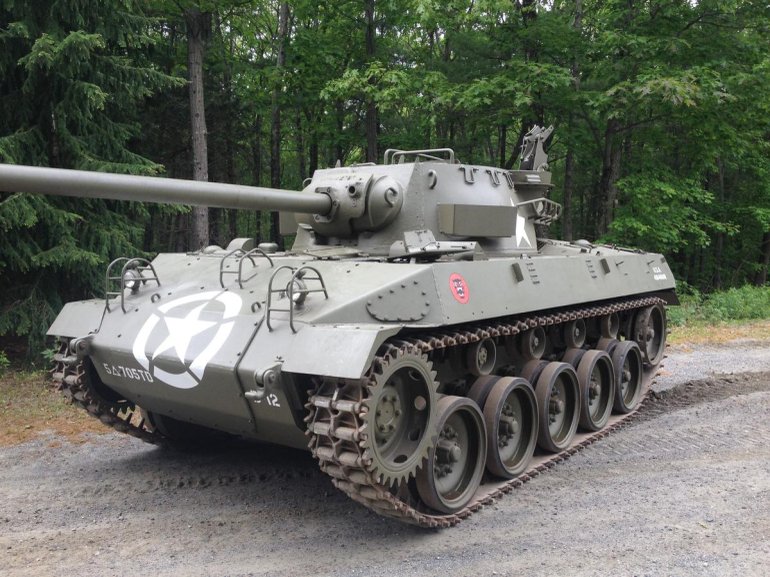
This vehicle was restored from an empty hull in 2012-2013. It has the more powerful R-975 C4 motor which makes it the fastest most powerful WWII tank you will drive. The motor was rebuilt in 2013 as well and runs perfectly. The tank has a little joe generator which is fully functional as well as a functional turret motor. Gun is not live, and the breech has been demilled.
-
Fort Ebey
We’ve written before on the coastal defenses of Puget Sound, mostly focusing on the turn of the 20th century Taft/Endicott period forts such as Ft. Casey. The beginning of World War II saw a massive investment in more modern coastal defenses, along both the Atlantic and Pacific coasts, and such places as the Panama Canal Zones. Bureaucratic inertia being what it is, by the time most of these forts were ready for service, it was abundantly clear, particularly along the West Coast, that no invasion fleet would reach even the central Pacific, let alone Hawaii or the actual continental US.
In 1942, the Coast Artillery Corps decided to upgrade the defenses of Puget Sound with a modern coast artillery battery located a few miles north of the existing Ft. Casey. It was to comprise a battery command post, an SCR-269A fire control radar, and two M1905A2 rapid fire 6” guns mounted on semi-armored barbettes.

Image via Fortwiki.

Image via Fortwiki. 6” gun at Ft. Columbia. Note the older Endicott period emplacements in front of the mount. None are at Ft. Ebey.
A quick look at this image from Google Earth tells us that the fort was well sited to cover any approach to Seattle.

Mind you, this doesn’t even take into account the other batteries, including 16” batteries, along the Strait of Juan de Fuca, the entrance to Puget Sound.
The only problem is, the battery wasn’t completed and ready for service until March 1944. By that time, the fighting in the Pacific was taking place in the Carolines Islands roughly 5000 miles away. All the effort to complete the fortifications were superfluous to actually winning the war. The guns of the battery were removed sometime shortly after the war. The concrete support structure was not demolished, however. Turned over to Washington state in 1965, it opened as a state park in 1981, and has been a popular park ever since, with its quaint trails and gorgeous view of Puget Sound.
-
The Belmont Club looks at the next war in the Pacific
Unfortunately, PJ Media doesn’t play well with my browser, so it’s hard to excerpt. But Richard Fernandez gives a nice history and geography lesson showing how any future conflict in the far western reaches of the Pacific might play out. Understand, something over a quarter of the world’s population lies in those waters, and the merchant shipping that keep them alive is the key to life itself.
-
Let’s take a journey to the dwarf planet Ceres.
Ceres is the largest object in the asteroid belt between Mars and Jupiter, and is commonly referred to as a dwarf planet. NASA’s Dawn spacecraft imaged it recently, and have shared their results in an animation.
-
Why China Wants Aircraft Carriers | The National Interest
China’s recent release of its first strategic white paper signals its official emergence as a maritime—and therefore global—power. Little in the document should surprise those who have monitored China’s rise, though it remains to be seen whether China watchers will discern nuance and inscrutability instead of taking Beijing at its word. Simply put, China views the United States as Asia’s hegemon, and its strategy seeks to deprive the United States of this role.
In its quest to eject the United States from a position of power and influence in the region, China has embarked upon a naval building and modernization program. At first, this program seemed aimed at rendering U.S. wartime support to Taiwan moot after the 1996 Taiwan Straits crisis. The effort included weapons and platforms designed specifically to target U.S maritime power projection capability—primarily resident in the air wings of its nuclear-powered aircraft carrier force. Early on, some assigned non-threatening motives for the buildup given the sensitivity of the Taiwan issue to Beijing. Yet over time, China began to develop weapons and sensor architectures far beyond those necessary or even useful for Taiwan scenarios. The Chinese naval program began to lay the foundation for regional maritime dominance and global influence by building modern multi-purpose destroyers, nuclear attack submarines, amphibious vessels, and an improved logistics force.
via Why China Wants Aircraft Carriers | The National Interest.
Bryan and Mackenzie have a great piece. Read the whole thing.
China has been building a world class navy for 20 years now, and is committed to continue doing so. Not traditionally a maritime power, China also has a long, long history of being invaded and occupied by maritime powers- nations that tended not to get invaded themselves. Ergo, become a maritime power.
Which makes perfect sense from China’s point of view. And indeed, while China is pushing hard to become a regional hegemon, they do not have the expansionist tendencies that say, Russia has historically had. That’s not to say they won’t strive to expand or exert influence upon neighbors, or even convert them to satraps. It merely explains why they do as they do. China sees mastery of the South China Sea and the East China Sea as absolutely critical to their own defense and sovereignty.
-
A Scathing Indictment of the Wounded Warrior Project
Over on the porch. Well worth the read.
I haven’t liked that organization for quite some time, mostly because of the way they portray wounded Veterans as being objects of pity. Salamander puts it better than I have been able to.
an organization that uses the same visuals, tone and background music for those who fight our wars, that are are also used for starving African children … and at the same time squash local organizations using a huge legal budget.
Touché.
Here is some perspective, without minimizing the sacrifice. The total US combat wounded in 13 years in Iraq and Afghanistan numbers around 52,000, with the vast majority being minor wounds with RTD (return to duty), such as mine were. (Of the approximately 1,400 wounded suffered by 1st Marine Division in Anbar from February-September 2004, about 1,200 were RTD. If those percentages hold for the larger number of 52,000, the total number with wounds serious enough to prevent a return to duty numbers around 7,500.) We know that the number of traumatic amputations is fewer than 1,600. This means, with just the last three years of donations, WWP has received enough money for almost $100,000 for each of the 7,500 seriously wounded Vets, or $457,000 for each traumatic amputee. This is on top of the medical care and equipment provided by the VA for these Veterans.
With a CEO salary of almost half a million a year, the selling of donor lists, and this sort of reprehensible behavior:
According to a number of smaller groups, the Wounded Warrior Project… has been spending a good deal of time and money suing other veteran-serving nonprofits on the basis that their names or logos constitute infringement on their brand.
I agree with Salamander, not a dime to WWP from me. I will give to a smaller charity in a heartbeat. One that does not make helping our wounded Veterans a “common business practice”, and one that does not intentionally harm others trying to give back to those who gave so much.
UPDATE: XBradTC here. C0ncur all and endorse original message. There are many fine organizations to donate to, and it’s your money. But I would like to mention one that does have a sterling reputation, Fisher House.
-
Sunset

-
Army's Public Website Hacked by Unknown Intruders – NBC News
Defense officials confirm the official public Army website has been hacked by unknown intruders demanding the U.S. stop training rebel fighters inside Syria.
Unlike the massive hack into Office of Personnel Management records, the officials stress the website contains no official classified information or private personal data of any Amy personnel, military or civilian.
The messages reportedly proclaimed “YOU’VE BEEN HACKED” and added “YOUR COMMANDERS ADMIT THEY ARE TRAINING THE PEOPLE THEY HAVE SENT YOU TO DIE FIGHTING.”
via Army’s Public Website Hacked by Unknown Intruders – NBC News.
The Army is really bad at internet. For instance, they don’t even own army.com.
This is the “white” space, with no operational stuff on it, intended for the civilian population. Still, it’s rather embarrassing.


-
Subscribe
Subscribed
Already have a WordPress.com account? Log in now.
 XBradTC