-
HEP-T
One of our earliest posts here was an explanation of HEAT rounds ands Sabot. Those, of course, aren’t the only possible projectiles for a tank main gun, but they are the primary anti-tank rounds.
Our friends at Think Defence reminded us of another approach, popular in the 1950s.
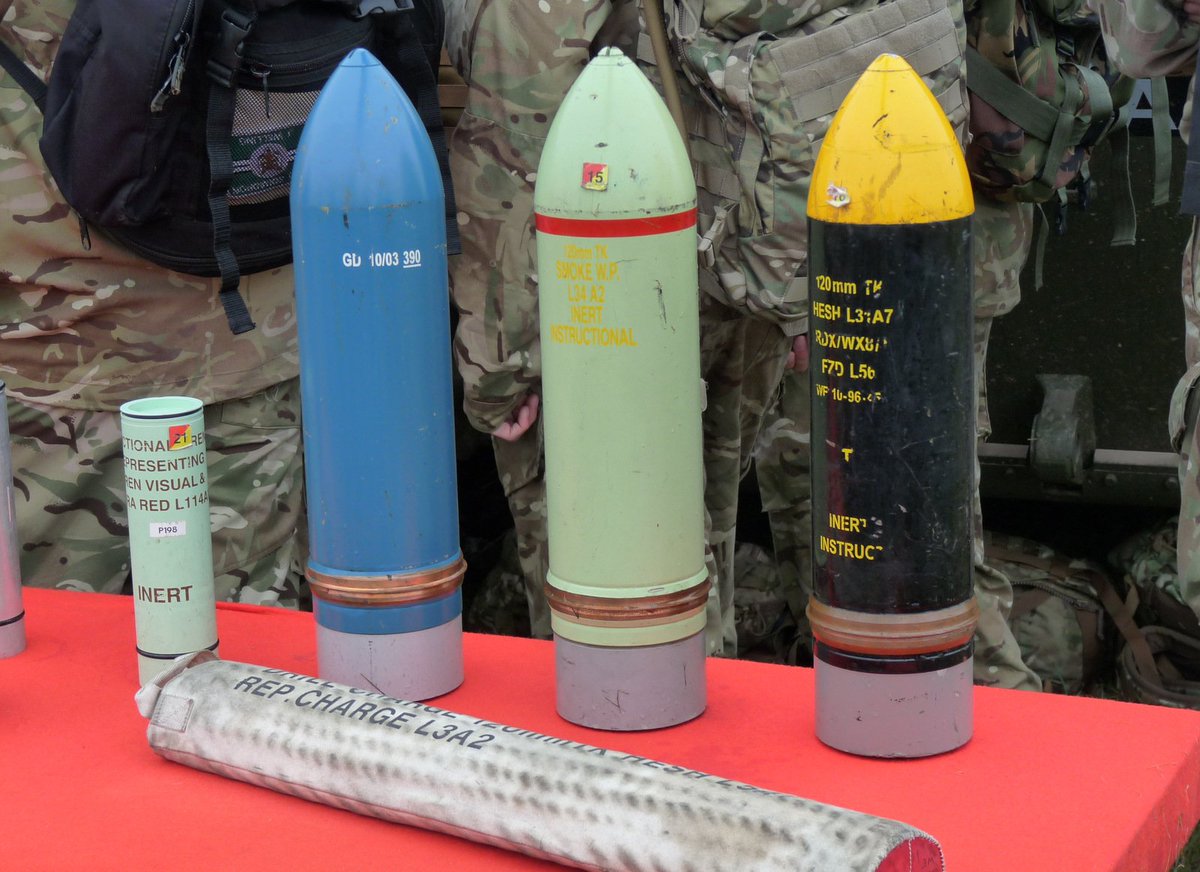
HESH, High Explosive Squash Head, also known as HEP, or High Explosive Plastic, was a round that was simply a big old lump of plastic explosives in a very thin walled container. When the round struck armor, it would not penetrate at all. Rather, it would squash up against the armor, flattening out. A slightly delayed fuse in the base of the projectile would then detonate the charge.
The shock of the blast would not blow a hole in the armor. It would, however, cause sheering stresses on the far side of the armor, resulting in spalling. That is, parts of the interior surface of the armor would break off and fly about the inside of the vehicle at high velocity, either incapacitating the crew, or setting off ammunition or other flammables.
The HESH was primarily popular with the British. US forces tended to stay with the HEAT round. HESH was quite effective against early Cold War Soviet tanks such as the T-54/55 series, and the T-62. But its greater weight than a heat round meant a lower muzzle velocity, which in turn meant less accuracy. On the other hand, HESH was also quite effective against fortified positions, something HEAT wasn’t always very effective against.
The only routinely fielded HESH round in the US Army was a very low velocity round for the 165mm demolition gun on the M728 Combat Engineer Vehicle, where it was used for reducing obstacles.
Modern composite armor and relatively light and inexpensive spall liners (such as Kevlar blankets inside Bradleys) have rendered HESH rounds mostly obsolete.
-
The Futility of Obama’s Air Campaign against ISIS.
In the wake of the heinous slaughter in Paris, the French have stepped up attacks on ISIS installations in Syria. The targeting information came from the US. That leads to the question of, wut, if we know where the targets are, why didn’t WE attack them? Because while Obama wants to act as if his campaign against ISIS is accomplishing anything, the administration has so hamstrung commanders that they cannot even pick the lowest hanging fruit on the target tree.
Targeting fuel trucks used to be off limits because of the civilians operating them, but shortly after the Paris terrorist attacks the rules of engagement changed. Before destroying the tankers the USAF, using F-15s, dropped information leaflets telling the drivers to scatter as an attack was imminent. To show the drivers that USAF was serious they had A-10’s conduct strafing runs close to the trucks an hour before the strikes.
Illicit oil sales are the prime source of ISIS funding. That makes the transports a legitimate infrastructure target. But for a year now, we’ve blithely let them operate unimpeded for fear of civilian casualties.
I’m not for indiscriminate bombing aimed merely at causing misery and mass casualties. But ignoring legitimate targets, targets that if destroyed can have a positive effect, is insane.
Given that two AC-130s and four A-10s were able to attrit about 10% of the available ISIS transport truck fleet overnight, even with the stupid restrictions imposed, tells you just how easy a target set these trucks are.
But they’ve been off limits all this time.
Because it’s not important to Obama. Literally, winning isn’t important.
Ain't nobody got time for THAT. https://t.co/As7N08CFIa—
Aggierican (@aggierican) November 16, 2015 -
Daily Dose of Splodey
Sadly, they’re replacing the FIFA headquarters. And it was empty when they dropped it.
-
Good old triple strand concertina wire.
Armies use obstacles to influence the enemy’s actions on the battlefield. They can be used to delay, divert, turn, or channelize a force into the ground of your own choosing. What they very rarely can do is actually stop an enemy.
Some typical military obstacles include minefields, anti-tank ditches, and of course, wire obstacles such as barbed wire and concertina wire.
The normal emplacement of concertina wire is what’s called the “triple strand” where to rolls side by side on the ground are topped by a third roll above.

The triple strand obstacle is just a touch too tall for someone to jump over, and the barbs of the concertina wire make it virtually impossible to clamber over. It’s hard to see in the above figure, but the rolls are held in place by stakes on alternating sides of the obstacle every 6 paces.
By itself, a triple strand obstacle isn’t that hard to breach. It can be manually breached with wirecutters. It can be mechanically breached by using a grappling hook and a cable pulled by a vehicle to rip it out. It can be explosively breached by Bangalore Torpedoes or the MCLIC or APOBS.
Of course, your enemy won’t make it that easy for you. It’s a military truism that if you’re not observing your obstacle, it’s not an obstacle. Instead, most obstacles, particularly those used to channelize, are carefully crafted kill zones, with preplanned mortar and artillery fires, interlocking machine gun, cannon and missile fires from protected positions. You might be able to breach the obstacle, but you’ll pay a price.
Furthermore, you’ll rarely come across just a triple strand concertina obstacle. Usually they are employed in conjunction with an anti-tank ditch (on the mechanized battlefield, at any rate) and depending on circumstances, a minefield as well. Each of these obstacles requires a different breaching method, which increases the time needed to breach, leaving you in a kill zone that much longer. Further, once you have breached, your follow on forces are forced into a narrow channel that makes an excellent shooting gallery.
Of course, sometimes, the enemy doesn’t have the time or material to emplace a fully integrated obstacle. You might get lucky and actually come across just a concertina obstacle.
In that case, if you’re mounted in a Bradley or a tank, you can just drive through it. But that tends to have its own drawbacks.

Been there, done that, and it is a flaming pain to get every single bit out of the running gear.
-
Truest words Obama has ever spoken.
Check out @hughhewitt’s Tweet: https://twitter.com/hughhewitt/status/666287761947648000?s=09
-
Hey, Mizzou…

As an added bonus, you’ll be virtually immune to microaggressions.
H/T: Vic
-
The Day of Battle- USS Hornet at The Battle of the Santa Cruz Islands
With URR’s excellent weekend posts of covering the turning of the tide of the Solomon’s Campaign at the 1st and 2nd Naval Battles of Guadalcanal, let’s look at another grim moment in the campaign. This one took place three weeks prior, and at the time, was seen as a defeat. Indeed, the battle of Santa Cruz would set the stage that would lead to the November battles URR chronicled.
The pattern of the Solomons campaign was that surface warfare groups of destroyers and cruisers and occasionally battleships would operate daily (or rather, nightly) in the waters east of Guadalcanal, in the famed “Slot” of the Solomon Islands chain. Major operations, such as reinforcement convoys, either US or Japanese, would receive wide ranging support from carrier task forces attempting to provide air superiority. Intelligence services on both sides tended to note when such surges occurred, meaning that if our forces sortied carriers, the Japanese would surge theirs as well.
In late October 1942, while the issue ashore on Guadalcanal was very much in the balance, and the Japanese planned a major offensive by ground forces on the island to pierce the American lines. Supporting the operations ashore, the Japanese planned a major naval effort. The US Navy moved to counter this effort.
On 26 October, 1942, north of the Santa Cruz Islands, the Japanese and American carrier fleets would clash. During the battle, the USS Hornet, the newest carrier in the fleet, would be left a smouldering wreck, to be later sunk by Japanese destroyers.
One of the most amazing aspects of this battle was that the attack on Hornet was actually filmed by Navy combat camera crews.
The other US carrier, USS Enterprise, would be heavily damaged. Of the eight carriers the US Navy built before the war began, only three would survive the war. USS Saratoga, USS Ranger, and USS Enterprise. Ranger was in the Atlantic, readying for the invasion of North Africa, and Saratoga was in drydock for repairs after being torpedoed by a Japanese submarine in August. USS Enterprise, badly damaged in the Battle of Santa Cruz, was repaired in forward waters. For a brief time, the US simply had no available carriers.
But while the US was losing carriers at an appalling rate, they also had literally dozens of fleet and light carriers under production.
The US Navy grasped that, but that was cold comfort when the Japanese Navy still possessed a force of several excellent fleet carriers.
What the US Navy soon grasped though, was that the heart of Japanese Naval Aviation wasn’t the carriers, but the naval aviators. The US Navy had a stupendously large training establishment that would churn out thousands upon thousands of well trained aviators. The Japanese, on the other hand, had a small, elite cadre of exquisitely trained carrier pilots. Unfortunately for Japan, the sustained operations since Pearl Harbor, and the very heavy losses of the Battle of Santa Cruz had gutted the ranks of aviators. The remaining Japanese carriers simply had no one to fly from their decks.
The Japanese Navy would spend the next 18 months struggling to train aircrews for their carrier fleet. But lacking the investment in training resources the US could apply, they managed to produce numbers, but not quality.
The shortcomings of Japanese training would be apparent when, a year and a half later, the US invaded the Marianas. Officially the Battle of the Philippine Sea, the Great Marianas Turkey Shoot would see the results of 18 months of training utterly devastated by well trained US carrier air wings in possibly the greatest one sided aerial massacre of all time.
To this day, the US Navy spends a ridiculous amount on training its aviators. And it is worth every penny.
-
Load HEAT- Lea Seydoux
Now seems like the time to savor the finer things France offers us, including one of the Bond Girls in Spectre, Lea Seydoux. H/T to a tipster.


-
Angles and Dangles, and Then Some

Sequence of Events
15 to 30 Seconds After Loss of AC Power
The rate of change of increasing down angle accelerated rapidly from about 15 degrees down to approximately 40 to 45 degrees down; with full speed ahead still being answered.
The starboard controllerman on watch in the maneuvering room picked up the XJA circuit (inter compartmental sound powered phone system) but heard no conversations.
The Officer of the deck took the hand telephone from the helmsman and ordered “All stop” and immediately “All back full”. There was no response to this order, nor was it heard in the maneuvering room.
The after torpedo room watch picked up the hand phone (XJA circuit) and heard no conversation on the phone.
The diving officer ordered “Blow bow buoyancy” and the auxiliaryman responded to the order. In addition the diving officer ordered the stern planesman to shift to emergency and the stern planesman responded to the order.
The commanding officer entered the control room and was able to pull himself to a position between the ladder from control to conning tower and the control room table.
One of the chiefs fell to the forward end of the forward battery as he attempted to climb into the control room.
Holy moley. Read the whole thing. Especially “Lesson Learned and Action Taken” Number 5. Drills and discipline. Rote memory. Training, training, training. Not a word about SAPR or human trafficking, or Diversity…
H/T (not surprisingly) Grandpa Bluewater.
-
Don’t bring an SUV to a TOW fight.


-
Subscribe
Subscribed
Already have a WordPress.com account? Log in now.
 XBradTC