By
·
Tags:
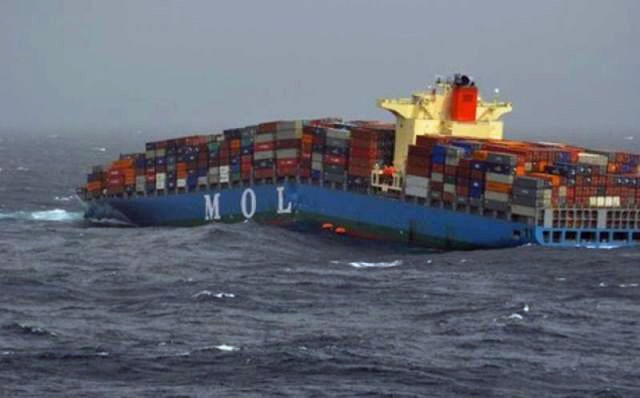
I expect this ship hasn’t had it’s 5 year inspection in 20 years or so…either that, or someone deeply screwed up the weight loading plan on those conex’s. I think #2. Either way, it’s “abandon ship!” cause that turd ain’t gonna float much longer.
LikeLike
Brad, the proper term for that situation is hogging. They overloaded the ends, and that’s result. Used to see such things in wooden warships. Cannon are heavy things and shipwrights had to learn to properly distribute the load of the guns to prevent hogging.
That’s the worst case I’ve ever seen.
LikeLike
She later broke up, but as of about 36 hours ago, both pieces were afloat and salvage tugs were enroute. Someone has a LOT of ‘splainin’ to do!
LikeLike
Here is a good write up of what is happening or has happened.
http://gcaptain.com/mol-box-ship-suffers-broken-back-sinks-off-yeme/
LikeLike
That’s definitely NOT going to buff right out.
I’ve had nightmares of looking back and only seeing half a barge behind me. It doesn’t happen often, but it does happen. Having crawled through my fair share of tanks, voids, holds and bilges during ABS inspections, the obvious is easy to see. Cracked welds, wasted steel, deformed/damaged plating and the like. Fatigue and stress micro fractures, not so much.
Even if you load your cargo according to stow, weights distributed evenly (and there is more to it than just that, it has to be loaded/unloaded in such a manner as to cause the least amount of stress on the hull, in conjunction with ballasting), hazardous/non-hazardous separated in accordance with local/international laws, in the end the seas, weather and Murphy can all conspire to hand you a bad day at sea.
LikeLike
Only problem with your theory there, is the boat is only FIVE years old to begin with. This, is seriously bad, something in construction, or materiels or both
LikeLike
The weight loading plan is likely part of the problem, but the liquid loading
(POL and water ballast in empty tanks, or lack thereof) is a significant part of the stability calculations which must be made before sailing.
The responsibility rests with the Chief Mate and (in terms of accurate figures and caution in compensating for fuel burned) partly extends to the Chief Engineer. Construction defects are possible, but weight distribution along the hull girder must not exceed the strength of said hull. If you hit swells at the right angle of the right (or more correctly wrong) wavelength harmonic effects can make it worse, but this has happened alongside the pier as well in open ocean with swells of a very long fetch.
The two pieces need inspecting, but my money is on a lazy sloppy ships company.
Of course I could be wrong. Maybe…
Chancy business, if you don’t take care of business.
LikeLike
Certainly don’t have the experience that others do here with ship construction or operation. However, I do recall reading about faulty welds on the early liberty ships, iirc they had issues with the welds when the temperature dipped below a certain point, the strength of the weld dropped off and so did the nose of the ship. Superficially, it looks like a similar failure to me, although, who knows.. http://en.wikipedia.org/wiki/SS_Schenectady
I think it’s pretty interesting that this is the first ship that used this particular grade of steel. So the yield strength is higher, that’s nice. How’s the fatigue resistance? Ductility? Lots of room for unintended or unforeseen consequences.
Still, it’s cool to see a ship broken in half and much cooler that everybody got off safely. Not so cool if that was a container ship carrying my company’s product (although it’s insured).
LikeLike
One of Roamy’s first posts here was on that very topic:
http://xbradtc.com/2010/11/15/liberty-ships-and-the-environment/
LikeLike
Nope. Part of “Ships Systems Engineering I” back in 1988. Hogging, sagging (which, honestly, is just as likely here), torsional twisting, all kinds of good stuff. Just an overview, really – the course was more about steam plants than structure- but it stuck with me.
LikeLike
[…] posted a pic That’ll Buff Right Out a few days ago. The container vessel MOL Comfort suffered a failure of the hull structure, and […]
LikeLike


Leave a Reply