There have been many stories in the news about the inadequacies of the Humvee as a fighting vehicle in Iraq, complete with tearful stories about soldiers killed in IED attacks. In 2004, the issue of inadequate armor was used as a club to beat Secretary of Defense Donald Rumsfeld over the head. The fact of the matter is that many, many soldier did in fact die in IED attacks on Humvees. That doesn’t mean the Humvee is a bad truck. What it means is that he Humvee is being used in a role for which it was never really intended.
In the late 1970s and early 1980s, the Army’s fleet of light wheeled vehicles was tired and obselete. The most famous of these was the jeep, which had evolved from it’s WWII beginnings into the M151 Ford MUTT (Multi Use Tactical Truck). The jeep was known as a 1/4 ton truck, that is, it could carry a payload of 500 pounds.

Slightly larger was a collection of 3/4 ton and 1-1/4 ton trucks. Some were off the shelf purchases of Chevy Blazers and pick-ups.

Other trucks included the 1-1/4 ton M561 Gamma Goat. This was the loudest, most uncomfortable riding truck around.

None of these trucks had the combination of durability and off road capability in a lightweight package that the Army was seeking. In the late 70s the leading contender to replace the jeep was at one point actually a Lambroghini. How cool would that have been?
 As it turned out, AM General, then a division of American Motors (who gave us classics like the Gremlin and the Pacer!) developed what the Army called the “High Mobility Multi-Wheeled Vehicle” or HUMMWV. Now, HUMMWV is hard to pronounce so everyone calls them Humvees. Yes, the civilian version is called a Hummer, but few if any people in the Army call them that. The basic design is a four wheel drive, four wheel independent double wishbone suspension 1-1/4 ton truck with a 6.2 liter engine. The design was intended to fill a number of roles by adding components to the baseline vehicle.

Most of the trucks were intended for logistical or command roles. As an example, the CO of a Mechanized Infantry company can’t go everywhere in his M-113 or Bradley. Sometimes, all he needs is a truck. So, in addition to his fighting vehicle, he has a Humvee.
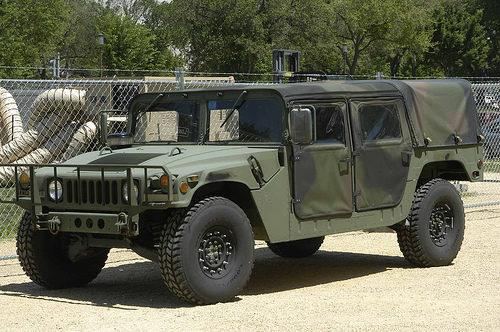
Similarly, the First Sergeant, in his role as the chief logistician for an Infantry company has a truck as well. His is tailored more to hauling troops and supplies.

At the same time, other models were intended to be used as ambulances and carriers for the TOW missile system.


These vehicles had Kevlar armor, but that was intended to stop the odd stray fragment, not withstand a dedicated attack. In fact, it wasn’t until the Battle of Mogadishu in 1993 that the Army started to condsider that there was a good chance a lot of its fights in the future would be against insurgent type forces and in urban areas at that. The Humvees in Mogadishu had suffered badly under rifle, machine gun and RPG fire. Most of the crews fared reasonably well, but the trucks were a mess and the Army knew it could do better. It soon contracted with AM General for up-armored versions that would provide better protection against small arms fire. Soon, limited numbers of these trucks were in production. But the improvements came at a cost- increased weight. All that armor weighs a lot. It decreases the speed and agility of the truck. It also puts a huge strain on the drivetrain. Breakdowns are more common. The trucks center of gravity rises and it becomes more likely to roll over. Still, a small number of these up-armored Humvees were used in the Balkans in the 90s and were available for use in Iraq. So from a lightweight pickup truck, the Humvee, now mounting a plethora of machine guns, was suddenly the prime vehicle for patrolling and fighting in urban centers like Baghdad.

One threat that Army hadn’t given enough consideration to was the IED or improvised explosive device. While the armor on an up-armored Humvee was enough to mitigate the effects of most roadside IEDs, the truck just couldn’t withstand the blast of an IED buried in the road or an anti-tank mine. There really isn’t a whole lot that can be done to improve the Humvee against mines. The design of the vehicle just doesn’t have that much room for growth left. Armor has been added to the floors and some work has been done to mitigate the effects of blast, but the fact remains that as fast as you can armor a vehicle, the enemy can use bigger mines. The current state of the art in Humvees is the M1151. Virtually all Humvees used in Iraq today for patrols are either the original up-armored M1114 series or the M1151 series of trucks. They provide protection against small arms fire and some protection against RPGs and IEDs. But they are by no means main battle tanks. If you want a tank’s level of protection, you end up building a tank.

By now, some of you are saying to yourselves, “But what about MRAPs?” Well, yes, the Army and Marines have both bought a bunch of MRAPs. MRAP stands for Mine Resistant Ambush Protected vehicle. They are based on a design originally from South Africa. They are more resistant to mines, and have good protection against small arms, but that comes with a price. The MRAP is a much larger vehicle. Many drivers complain that they cannot move the MRAPs through the small alleys and tight lanes in a city the way they could with a Humvee. They are even more prone to rollover than a Humvee. So while there is a place for them, they aren’t the ultimate Humvee replacement.
 The Army is still trying to find a good vehicle that combines the protection of an MRAP with the light weight and agility of a Humvee. But the problem will remain that every time you come up with better armor, the enemy will use a bigger warhead. The ultimate answer won’t be technology alone. It never is. It will still take brave young soldiers working in an incredibly difficult environment using their training and their initiative to win wars.


Leave a Reply