I’ve mentioned the role Sergeants Major have played in a few of my escapades. It is an old job, but the way it is currently constituted is rather new.
Almost as long as there have been armies, there have been Non Commissioned Officers, and the senior NCO in a battalion or regiment has long been the Sergeant Major. NCOs lead, both by tradition and by the authority granted to them by law. They are responsible to their commanders for training their soldiers in their duties, setting the standards of acceptable conduct, and inspecting their soldiers to see that they are ready for battle. For centuries, the commander chose the best soldier in his unit and made him the Sergeant Major. In effect, he was appointed to the office and served at his commander’s pleasure. If a new commander came in, it was not unknown for a Sergeant Major to find himself a private the next day.
Over time, the organization and personnel policies of the Army changed. Eventually, the Army found itself with 7 paygrades, E-1 to E-7. But the E-7 position was interesting. There were three ranks available at that paygrade- Master Sergeant, First Sergeant, and Sergeant Major. A soldier might check into a unit and find himself appointed the Sergeant Major. At least he wouldn’t find himself busted back to Private unless he had committed some gross breach of discipline.
But the having the three senior NCO job titles all filled by soldiers at the same paygrade wasn’t satisfactory either. In 1957, Congress authorized the “supergrades” of E-8 and E-9. In the Army, E-8s would serve as either Master Sergeants or as First Sergeants (the senior NCO of a company). E-9s would be Sergeants Major.
A couple of years later, the program was modified to show the difference between those Sergeants Major that were serving on a staff and those serving as the senior enlisted advisor to a unit Commander. Staff Sergeants Major would see no change in their insignia, but those serving as the Sergeant Major of a battalion or higher echelon unit would now be known as Command Sergeant Major. Their insignia would consist of three chevrons, three “rockers”, and a star encircled by a wreath. To serve as the CSM of a battalion (or higher) would be the capstone of a very successful career. Indeed, no longer were Sergeants Major selected by a unit commander, but rather by a centralized system at an Army-wide level. A great deal of effort was expended to ensure that commanders at all levels had the finest available senior enlisted leaders.
Now, mind you, I was never very comfortable around Sergeants Major. Oddly enough, I was very comfortable around senior officers. I grew up around them. But not senior NCOs. My rule of thumb was to not bring the Sergeant Major’s attention to myself. If he really needed me, he knew where to find me. Let’s just say that some CSMs can be imposing figures.
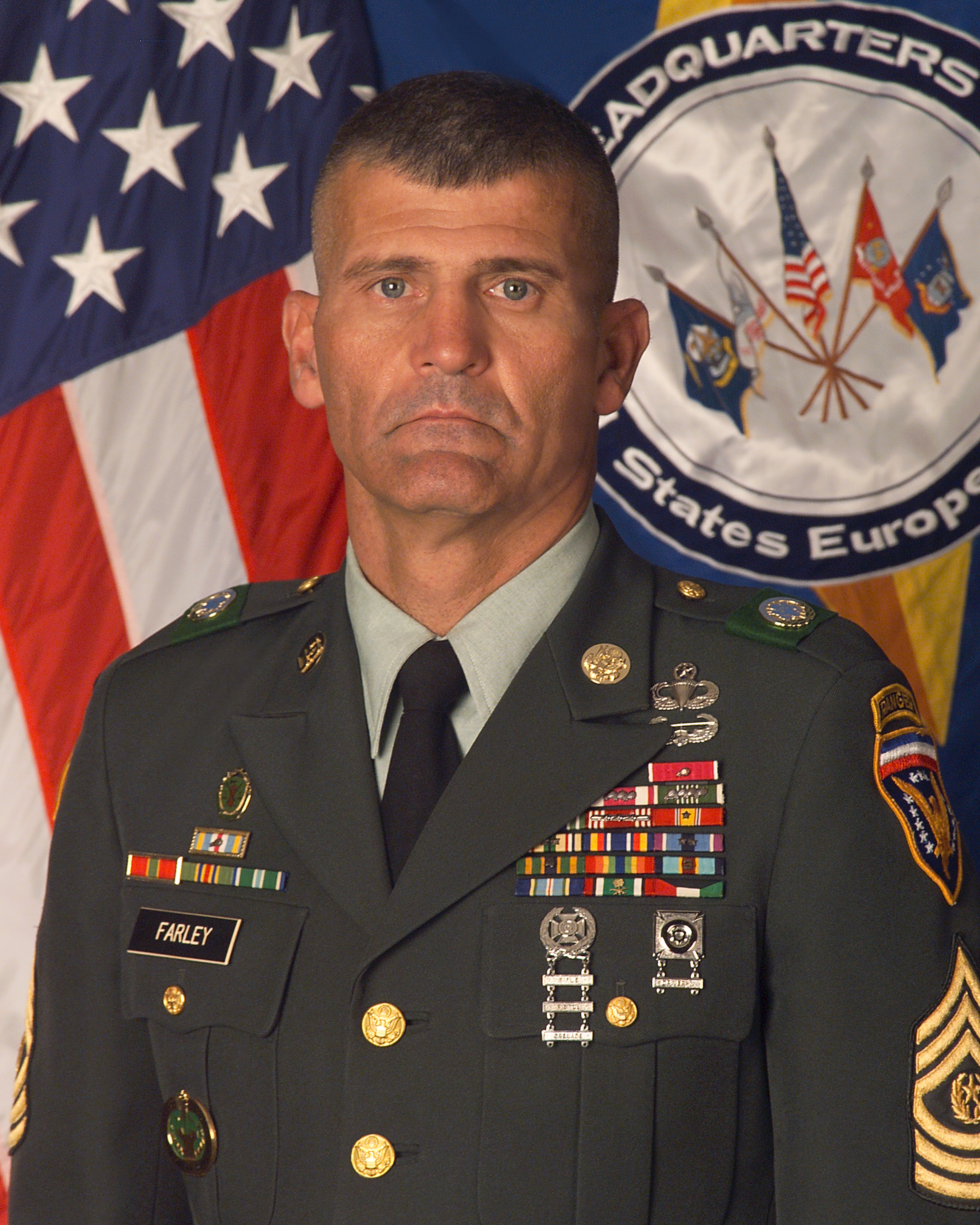
Now, I never worked for CSM Farley (pictured above) but he’s a fairly representative looking CSM. Not the kind of guy you want to have focused on you for your shortcomings.
So far removed from my days of service, I am no in contact with any Sergeant Majors. But one of my internet contacts is a retired U.S. Navy Master Chief, and I hope to have some of his thoughts about the challenges and rewards of serving at that level. Stay tuned.


Leave a Reply